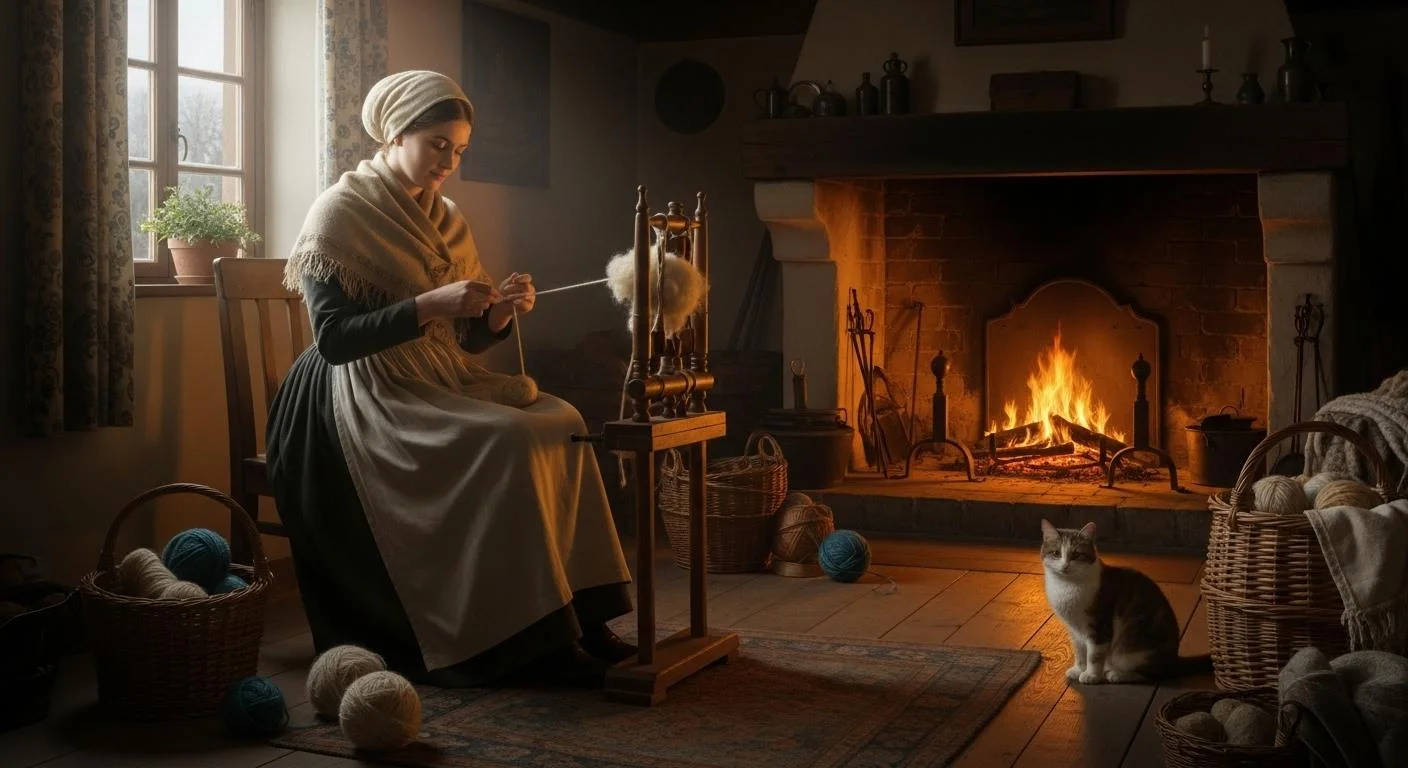
The date of January 7, the day of the distaff, marks the end of the festivities and recalls a heritage woven into the homes of Europe, either very much alive or discreetly forgotten depending on the place. Why does this day still intrigue, as winter stretches on and the fire dwindles in the hearth? You quickly notice the quiet strength of tradition that begins anew, season after season, paying homage to the gestures passed down and the return to creation. Some are astonished by the simplicity of the objects, the silence that follows the Christmas songs, and yet, the resilience of the distaff still fascinates. Here is the atmosphere, raw, direct, without detour, that brings back to life this January 7 where memory weaves ordinary life.
The meaning of January 7, the day of the distaff, what story to unearth?
Why have so many households maintained the tradition of January 7, the day of the distaff, while other celebrations fade away quietly over the centuries? This is not just any date; you do not turn the page without thinking about it, it is a milestone, a pivot, a reference point. From the moment the sun rises, the resumption of work at the distaff imposes itself quietly, no machine to mask the precise gestures, the thread returns between the fingers, ordinary life asserts itself.
The Middle Ages cling to January 7, chronicles signal it, texts confirm it, villages recall it, transmission, sharing, resumption, these words still resonate. You may wonder about this erased figure, this stick adorned with wool that connects generations, ensures survival, keeps the flame of the hearth alive. Ancient writings do indeed mention this date that closes the festive cycle to make way for the spinning of everyday life. Ultimately, the day of the distaff is recognized by the whisper of the thread and the rustle of shared memories, a marker firmly anchored in collective and social memory, far from the shiny artifices of modern January.
The medieval origin of the day of the distaff
To embark on the journey of this tradition is to traverse the thickness of the centuries without ever losing sight of the simple gestures, those of the thread being drawn. January 7, the day of the distaff, you remember it, it is the affair of a rural world, of a society that curbs the joy of feasts to return to the vital foundation, manual labor, ordinary solidarity, the resilience of women, above all. The medieval roots maintain a discreet but solid endurance, no one will admit to forgetting without resistance.
The cycle imposed by nature demands this resumption, each household harbors the same ritual, each object breathes a story, hard to disregard as the message repeats, every January, every generation. The gestures traverse oblivion, persist, glide into memories, awaken a silent and fragile heritage at the same time.
The characters and symbols of the day of the distaff
You encounter Saint Distaff in English writings. Amusing, this saint who is not entirely serious, adds rhythm to the celebration, sprinkling a pinch of humor on the rigor of the days. In France, the wink is out, rather focusing on objects, on wool, on the spindle, on this famous stick. The distaff alone summarizes a story of emancipation, sharing, work, sometimes tenderness. It carries the memory of the group, the artisanal sisterhood, the tales of proud elders passing on the "golden thread" of their childhood. There you have it, everything becomes clear, each tool matters, engraves itself in the ordinary, ultimately symbolizes an entire memory of women's work.
The traditions of the day of the distaff, diversity and regional surprises
January 7, the day of the distaff, is not celebrated everywhere in the same way, and that's a good thing. You find anecdotes while crossing the villages of the Massif Central, nothing is ever fixed, each family adjusts, invents, reinvents. There are contests, songs, meals prepared in chorus, nothing stuffy. On the English side, it's all about games, bonfires lit, sometimes the celebration turns into a masquerade with the playful figure of Saint Distaff. Germany is not left out; it tells legends, organizes grand meals, mixes tradition and dance.
The union of conviviality and transmission often surprises those curious who expect a simple ceremony; they discover a thriving universe of practices where objects come to life, where creativity flirts with nostalgia and humor. Some villages organize initiation workshops, families challenge each other to spin the finest ribbon, the exercise is taken seriously or with self-mockery, no one judges, everyone smiles around the fire. Each person takes hold of this heritage in their own way, without an official manual.
| Region | Main practices | Festive particularities |
|---|---|---|
| France | Spinning, songs, collective meals | Costumes, contests |
| England | Games, bonfires | Role of Saint Distaff |
| Germany | Narration of legends | Feasts, traditional dances |
The rituals of January 7 according to the regions?
Here in France, we focus on the art of thread among neighbors, elsewhere competition prevails, other regions indulge in legend while sharing a good dish. The English favor wild fires, the Germans open the ball with tales and hearty dishes. Always a ritual, never monotony, the shared effort gives way to song, conviviality settles in, even if modernity lurks, ready to erase this memory. A song to accompany the rhythm, a joke to lighten the task, here is the recipe that endures and binds the community, a complicity without pretense.
The popular tales and legends about the distaff
Sometimes you stumble upon improbable or richly fanciful tales. Here the distaff is adorned with mysterious powers, golden thread or amulet against winter fears, nothing really surprises. Agile women hope for a visit, that of a "spinning fairy," a symbol of prosperity, or the famous metamorphosis of a spinner transformed into a bird, sunrise, the thread breaks, the magic flies away.
These tales nourish the imagination, awaken curiosity, almost as much as the contests and meals. The attraction for the mystery surrounding the raw material never really dies, whether one believes in the legends whispered by the fire or not.
The regional overview of the practices of the celebration
It is about capturing the plurality of this ritual with a straightforward table, without embellishments:
| Region | Main practices | Festive particularities |
|---|---|---|
| France | Spinning, songs, collective meals | Costumes, contests |
| England | Games, bonfires | Role of Saint Distaff |
| Germany | Narration of legends | Feasts, traditional dances |
On a January Sunday in the Haut-Pilat, families gather. Église, 55 years old, shares her emotion:
"Nothing replaces the warmth of wool between the fingers, you feel the memory passing from the sharpness of the spindle to the curve of the distaff"
. The children watch their grandmother's hand, awkwardly trying to replicate the gesture. When the thread breaks, laughter erupts, a suspended moment, impossible to forget.
The disappearance and then the renewal, what are the stakes of the day of the distaff?
Are you questioning the disappearance of this tradition? Family rituals fall into oblivion when the textile industry rises, the pace disrupts everything, women leave the home, ancestral gestures falter. Transmission loosens, workshops close, domestic tasks change their face. The distaff remains in the background, almost mute, threatened by the acceleration of the modern world.
The official history turns away from it, collective memory diminishes, yet the strength of January 7, the day of the distaff persists among some diehards. Have you ever thought about the fragility of a tradition thus suspended over time, shaken by rampant industrialization? You then realize how much it hangs by a thread, fragile, precious, and threatened to end up as a mere paper memory.
The historical reasons for gradual oblivion
The industry dictates its rules, manual labor fades, the younger ones take up other languages, tradition folds, crumbles. The women's emancipation movement alters the model, family transmission loses its engine, the celebration sometimes survives only on the margins. Some memories resist, revive the subject, as soon as January 7, the day of the distaff arrives, then the dialogue resumes, the heritage reactivates, everyone gauges what is gained, what is lost in the current mutation.
The initiatives that revive the day of the distaff
The times change, museums, associations, engaged artisans never give up. The Museum of Spinning, for example, opens its doors to schoolchildren, multiplies workshops, conferences, presentations to prevent textile memory from slipping away. You read about the actions of the Textile Arts Association, they go through social networks, online tutorials, collective challenges, new vocabulary for young hands.
In January, the village of Saint-Hilaire comes alive without pretension, a market, costumes, the celebration regains momentum, families follow, no one looks at the clock. The return to spinning accompanies a shared desire, that of inhabiting this January 7 still recognized as the day of the distaff, no taboos, no moralism: just the energy of transmission, fragmentary, alive, and astonishing.
| Initiative | Type of action | Location / Scope |
|---|---|---|
| Textile Arts Association | Workshops, conferences | National |
| Museum of Spinning | Demonstrations, exhibitions | Regional |
| Local festival in St-Hilaire | Animations, artisan markets | Local |
Modern celebrations, how to revive the day of the distaff today?
Contemporary energy renews the celebration, nothing obliges to copy the old. You gather neighbors and friends in the evening, set up a family workshop, taste a dessert inherited from grandmother, creativity takes the lead. Instagram brings together enthusiasts, tips circulate, the competition for the prettiest ribbon entertains young and old, regardless of the result. One neighborhood decorates facades with wool garlands, another displays objects lent for the occasion, the feeling of collective belonging is reborn, even for one evening.
- Organize a friendly contest to spin the finest ribbon
- Gather around a regional dish shared among neighbors
- Decorate the neighborhood with ribbons and old objects
- Dedicate time to stories collected in the family or at the local museum
Ideas for a modern celebration?
Everything is allowed, the celebration, a creative contest, the big table, the family memory highlighted, weaving bracelets, photo exhibitions, skill games or recounting memories. The important thing remains the warmth of the gathered group, the common desire to perpetuate, transform, appropriate the tradition of January 7, the day of the distaff. Simplicity prevails, spontaneity takes precedence, that is what makes the essence of this day.
Resources available, learn and participate?
Do you want to delve deeper? Some concrete avenues exist: the website of the Wool Museum welcomes the curious, interactive, rich in documentation, accessible to all ages. The guide "Spinning and Heritage" compiles experiences, diagrams, anecdotes, all available in bookstores effortlessly. The Textile Arts channel sparks public curiosity with short, lively formats, where everyone can appropriate the history of thread. Heritage is shared, sometimes quietly, in the conviviality of a workshop or the surprise of a new video shared. Everyone finds their place, far from formatted speeches.
| Resource | Type | Link / Location |
|---|---|---|
| Website of the Wool Museum | Educational website | musee-laine.fr |
| Guide "Spinning and Heritage" | Book / Practical guide | Specialized bookstores |
| Video "Textile Arts" | YouTube channel | youtube.com/artstextiles |
January 7, the day of the distaff does not seek to impress or moralize, it simply invites to rediscover a breath, that of sharing, of the gesture transmitted or diverted, that which connects, for the time of a winter, entire generations around a thread that never quite breaks.