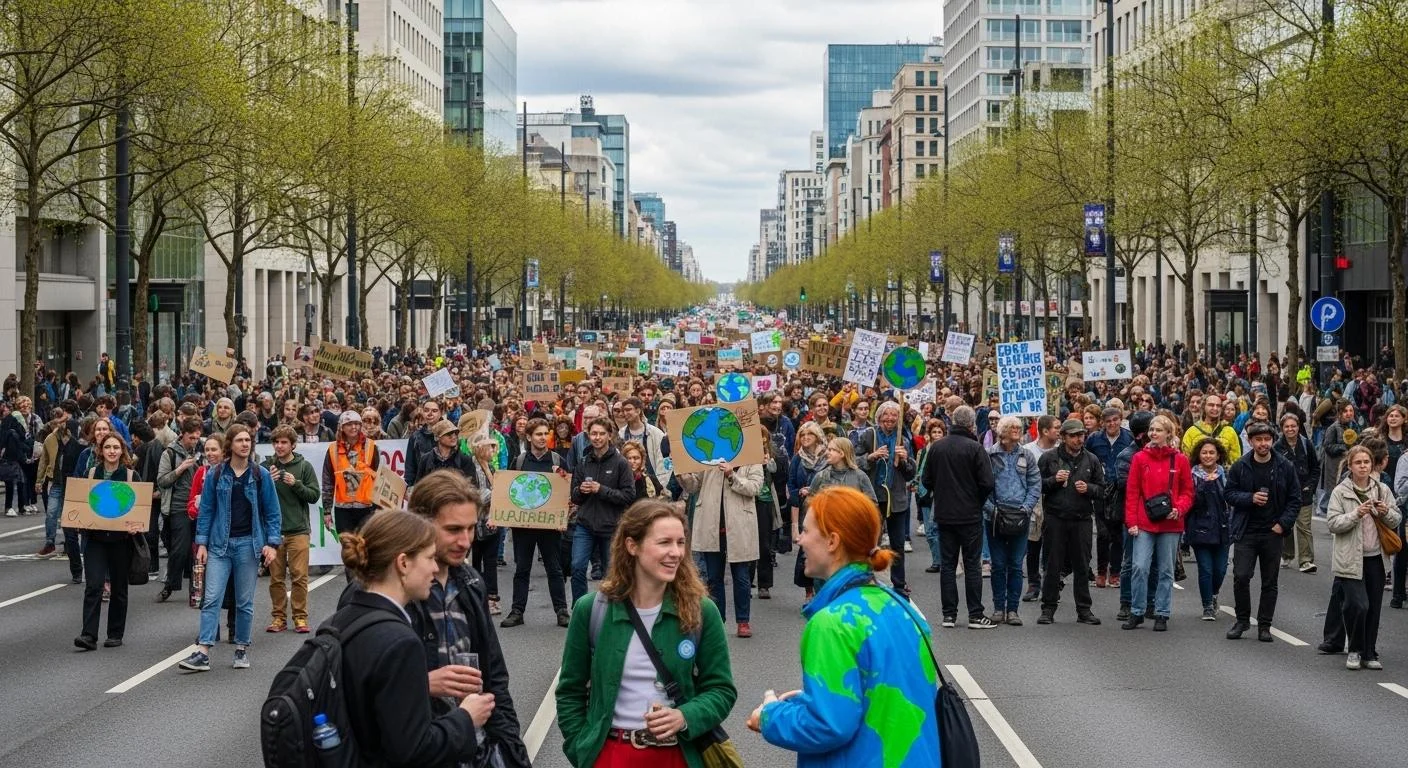
You have seen it, this wave that sweeps through society on March 3, this Global Climate Strike never goes unnoticed. The climate emergency hits you from the very first moments, impossible to remain indifferent. The streets overflow with collective energy, routine explodes, and faces display this shared sense of urgency.
The appointment on March 3 no longer resembles a simple date on a calendar; it marks a willingness to act together in the face of climate chaos. You witness a mobilization that imposes itself, shaking the skeptics and forcing the powerful to at least be attentive. Some scoff, others worry, but everyone keeps an eye on this crowd, denser and more determined each year. The Global Climate Strike inhabits public space, infiltrates conversations, and shakes up inertia. A demonstration, and everything shifts; you become a witness or an actor, rarely a mere spectator. March 3 shapes gestures, imposes awareness, accelerates debates, and awakens society.
The meaning of climate mobilization, origins, dynamics, and perspectives of March 3
To think that the Global Climate Strike arises from a simple outburst of anger, really? That would minimize the history and strategies that underpin it. This global movement is built in the wake of placards, but also of social networks; everything accelerates in 2018 when Greta Thunberg decides to sit alone in front of the Swedish Parliament.
On this March 3, urgency is written on every poster; international youth reacts, from Voltaire High School in Paris to the Chilean hills. Virality seizes the protest; every Friday expands the web of Fridays For Future, commitment gains ground; in Berlin, Nairobi, or Montreal, borders fall before the power of words and collective intelligence.
In France, Germany, or Italy, local dynamics assert themselves. High school students found Youth for Climate France, parents create their collective, Extinction Rebellion and other small organizations come to support. The Global Climate Strike spares no continent; the date captures public attention, political advisors are concerned, the press comes alive, the UN reacts, everything is interconnected. This is not just a story of visibility or diffuse messages; it is also a question of demands and concrete results.
Every March 3, aspirations and demands are displayed unambiguously; youth carries a message of equity and climate justice, respect for scientific data is imperative, the State and institutions are summoned to listen. India, Australia, or Kenya also participate; the pressure on governments is asserted. Silence is no longer an option in the face of this collective cry.
The origins of the student and citizen movement
The story takes a turn in August 2018 when Greta Thunberg chooses to sit alone in front of the Riksdag in Sweden. Her placard announces a school strike for the climate; the photo circulates, the press picks it up, Fridays For Future is born in the wake. This gesture touches a generation, sharpens impatience in the face of political slowness, awakens a sense of brutal urgency everywhere in the world.
France, Spain, Germany, several countries draw inspiration from the Swedish example, and suddenly, every Friday imposes itself as a day of mobilization. The movement expands; thousands, then millions of young people join the cause. Europe stirs, continents follow. A snowball effect, simple, direct communication, relayed by a youth expert in digital codes, that is the recipe for a mobilization that is impossible to stop.
In 2026, the numbers explode, over 2,000 mobilizations recorded in a hundred countries; participation grows. Greta Thunberg is no longer the only figure; she now embodies the spokesperson for a composite collective, uniting NGOs, unions, school, and university associations.
The expectations and demands of March 3?
On March 3, nothing is vague. The Global Climate Strike states its demands straightforwardly, refuses inaction, calls for serious consideration of IPCC analyses, demands climate justice and youth involvement in politics. You witness a frontal offensive against empty speeches, timid commitments; the climate does not wait.
The slogans resonate, "Change the system, not the climate," the reduction of CO2 emissions is prioritized, the objective clearly displayed; social inequalities also matter. Calls to action do not only target students; workers, urban or rural families rise to the challenge. The effectiveness of March 3 lies in this ability to federate around specific, tangible, urgent issues.
The main issues of the March 3 mobilization, who are the drivers, what strategies do activists adopt?
This March 3, the activist ecosystem asserts itself in all its diversity; Fridays For Future, Youth for Climate France, or Extinction Rebellion, the list keeps growing; the agenda evolves, tactics change, the classic school strike gives way to more targeted actions, marches, massive actions, silent sit-ins, or playful interventions; everything is organized at breakneck speed on Telegram, Discord, TikTok. The digital era is displayed, but traditional activism persists, with workshops, meetings, and appearances in local media.
| Organization | Influence | Type of action | Action area |
|---|---|---|---|
| Fridays For Future | High (global presence, constant engagement) | Demonstrations, digital campaigns, lobbying | International |
| Youth for Climate France | Medium to high (French youth mobilization, local relay) | Strikes, sit-ins, public debates | France |
| Extinction Rebellion | Variable (media impact, direct actions) | Blockades, occupations, awareness-raising | Europe, America |
| Parents for Future | Growing (family network, intergenerational mobilization) | Petitions, support, communication | Europe, World |
The actors that weigh in the battle
Student and high school associations take the initiative; young figures emerge, Adélaïde Charlier in Belgium, Luisa Neubauer in Germany surprise with their commitment. Greta Thunberg energizes the whole, relayed by an international community; the power of the collective is felt at every mobilization.
Youth marks the front line, but it never faces resistance alone; NGOs like Greenpeace or WWF accompany, support, finance, and provide technical assistance. Behind the slogans, teachers, parents, sometimes even vigilant local elected officials, civil society becomes a partner; the mobilization remains anchored in daily reality; the diversity of support strengthens the movement every March 3.
The methods that hit the mark
How many symbolic actions revolve around March 3, a myriad. Hashtags galore, #Climatestrike, #FridaysForFuture, #ActNow, campaigns flood in; the mobilization transcends the classic framework. Actions take shape, sit-ins in front of institutions, TikTok campaigns, or mega-petitions weigh heavily. No imposed format; creativity prevails, communication impacts without repeating itself.
Social networks resonate strongly; the collective organizes in real-time. In Montreal, in Nairobi, everywhere, you note the momentum of students, orality, spontaneity; everything plays out live. March 3 connects, motivates, galvanizes.
The repercussions of the March 3 climate mobilization on society and institutions
The effects do not linger. Leaders react; the Global Climate Strike shakes the political agenda; the UN, the European Commission, governments advance, announcements fall, green pacts, carbon neutrality, cities commit. In Paris or Vancouver, measures are implemented, traffic restrictions, promotion of clean energies. Resistance persists; some actors drag their feet, heated discussions guaranteed, but the dynamic does not wane; pressure mounts; no one avoids the debate anymore.
Media coverage intensifies; climate imposes itself everywhere; even businesses are revising their policies, their communication; impossible to avoid the ethical question of the 21st century.
The responses from public institutions
After each March 3, the European Parliament advances; politicians adapt their discourse; roadmaps change; youth participation is invited into legal texts. Public support swells; governors display themselves with youth, slogans slung over their shoulders, a willingness to show that they hear the street.
Criticism spares no one; lack of follow-up, delayed decisions, administrative inertia, heated debates in the press; the activist voice gains prominence. Transparency becomes the primary demand; the media play their part, increasing pressure on institutions.
The upheavals in society and in the media sphere
No one comes out unscathed from March 3; the Global Climate Strike accelerates the transformation of mentalities. According to the Climate Action Tracker, popular support progresses; the share of citizens who support environmental policies rises; media coverage intensifies continuously. Citizen assemblies emerge, structured by associations or spontaneously created.
| Type of change | Before March 3 | After March 3 |
|---|---|---|
| Media coverage of climate | Medium | Increased, continuous coverage |
| Citizen collectives created | About 1500 in 2022 | More than 2600 in 2026 |
| Public support for ambitious policies | 51% in 2024 | 67% in 2026 |
You feel the impact; businesses modify their communication; the trend towards responsible investment progresses. Schools reform their programs, raising awareness from primary school; the climate question imposes itself on all fronts.
Camille, a student in Lille, remembers, "Being in the middle of 5,000 people, that almost vertigo, suddenly, solitude recedes, questions flood in. Family discussions open up, voices are liberated. That day, the mobilization changes something, in intimacy and in the street."
The Global Climate Strike triggers sparks, breaks routines, opens perspectives that were previously stifled.
The future paths for climate mobilization after March 3
Since 2026, observers have raised concerns about citizen fatigue, political recovery, the multiplication of crises; the prevailing climate weighs on mobilization. How to maintain collective momentum, how to innovate, how to engage the public; pressure intensifies; activists seek new methods.
The experience of March 3 reveals some keys; the necessity to adapt, to renew forms, to give local meaning without disarming the global dynamic. Actors test, try new alliances, build networks, strengthen intergenerational dialogue, invent tools, deploy their imagination rather than confining themselves to routine.
- Combine on-the-ground mobilization and digital campaigns to reach all audiences
- Multiply educational actions in schools and universities
- Involve unions and engaged businesses to build shared solutions
- Encourage participation in citizen assemblies to strengthen political impact
The challenges awaiting future mobilizations
Activists discuss, organize, adjust strategies; the legitimacy of the movement is obtained through debate, the ability to transform demands into legislative reforms. Ground campaigns sometimes wear out; energy fluctuates; the need for inclusion becomes central; each crisis generates its own responses.
Without new momentum, the breath risks fading, but recent history proves that the collective knows how to bounce back, produce new dynamics, introduce new actors. Courage, perseverance, and creativity remain at the heart of the climate battle; a mobilization never really stops; it transforms.
What paths to strengthen citizen engagement?
The movement projects itself into the future, strengthening bridges between generations, multiplying awareness, pushing universities and schools to get involved; all scenarios are under construction. The Global Climate Strike seeks to sustainably inscribe itself in the social agenda; the goal is to emphasize urgency, to remind that nothing will be resolved without dialogue and collective involvement.
The year 2026 opens a new period; dialogue is sometimes rough with institutions; the place of youth in decision-making is no longer contested. The final question then arises, simply, after March 3, what remains? The sum of individual initiatives, gestures, nuances, a movement that writes itself daily, without relent. The mobilization has lost none of its relevance; the Global Climate Strike is tested and affirmed; every voice now counts.