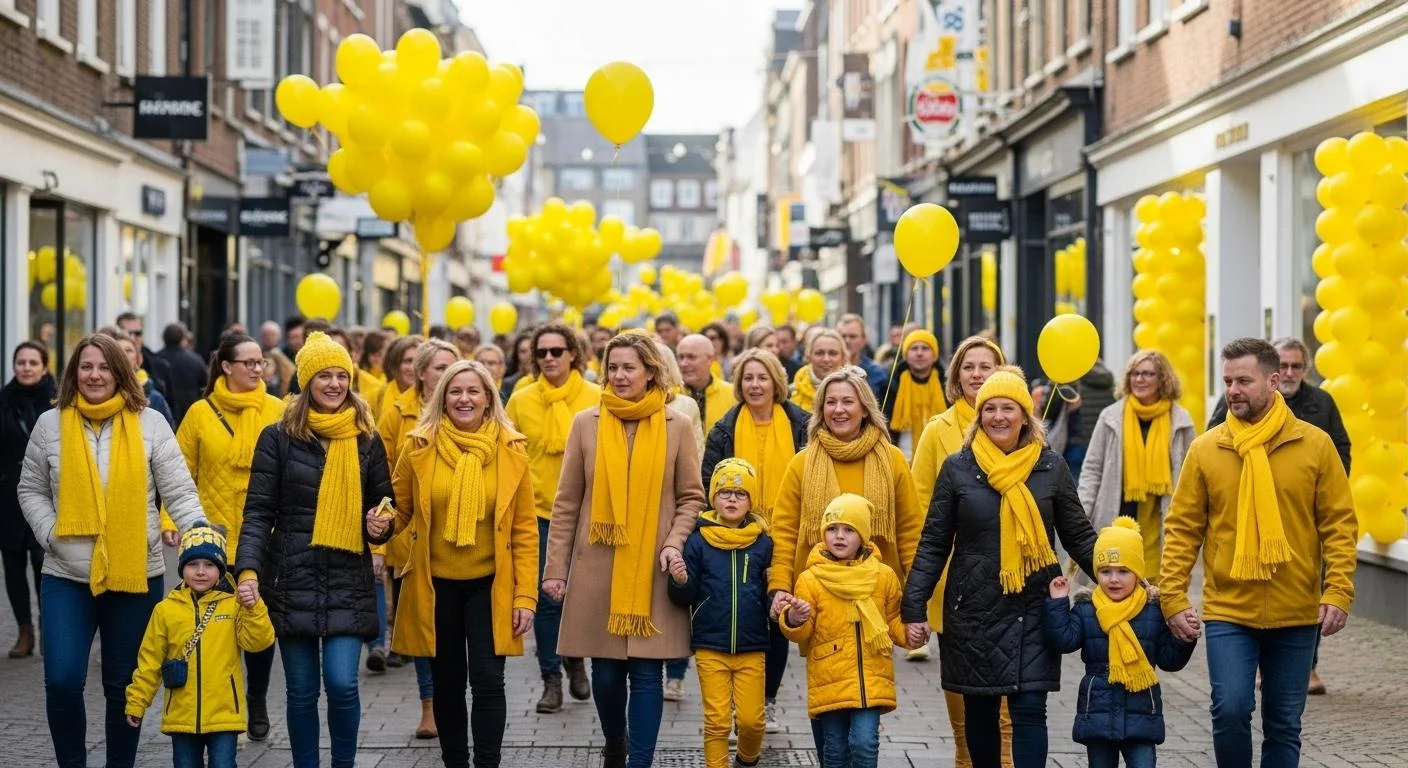
The impact of March 3 resonates far beyond a date on a calendar or a simple ribbon pinned to a coat. This appointment set by the Yellow Day has propelled endometriosis into the spotlight. Yes, a national day shakes up a firmly entrenched taboo, and society seems ready to listen. You surely notice this transformation that pushes the disease out of silence in 2026.
The recognition of the Yellow Day, anchoring and evolution on March 3
The Yellow Day does not emerge from a tradition or a fashion trend. The event was born in 2022 under the collective impulse of associations such as EndoFrance and Info-Endometriosis, bringing together the voices of those who were often ignored. Wearing yellow, participating in an online campaign, or joining a conference on that day is not playing a game; it is displaying a demand to end the shadow in which endometriosis was confined. This choice of a bold color expresses a desire to shine.
March 3 does not fade away. You may feel this new energy? For three years, the dynamic has exploded, media coverage has risen, the political world is interested, and nothing seems to slow down this wave of collective hope. Events multiply, speeches follow one another, networks electrify, and society finally accepts to face the suffering. This day appears as an invitation to speak, to tell, to support, to manifest, to demand.
The reasons behind the yellow ribbon, what are the origins of this color and this date?
March 3 is not randomly written on agendas. This new impetus comes with associations that finally give the fight a symbol, a structure, and above all, unprecedented visibility. Wearing the color yellow, participating in digital mobilizations, expressing oneself in the media – everything converges towards a fight against a disease that affects millions of women but remains largely misunderstood. Light, health, moral strength, that is what this color claims. The cry of March 3 becomes collective, it gathers, it shakes, it gives weight back to the speech. Why this March 3? Simple, the country demands this break with the heavy silence.
The slope seems steep, but the progress is rapid. In 2026, France saw the emergence of more than 230 local actions – workshops, conferences, symbolic mobilizations, ribbon distributions – all over the territory. The Ministry of Health actively participates, local authorities organize, and the issue imposes itself in public debate. We are not talking about a superficial event here, but about a solid, unifying mobilization, embracing a whole ecosystem of solidarity. A milestone has been crossed.
What are the differences then with other health campaigns or days dedicated to diseases? There is no mistake, it is about bringing suffering out of the shadows in a unique, deliberately strong, insistent dynamic.
The specificities compared to other mobilization days, how does March 3 truly stand out?
Have you heard of days dedicated to cancer, AIDS, or prematurity? How does the Yellow Day distinguish itself in this engaged landscape?
| Date | Name | Objective | Symbol |
|---|---|---|---|
| March 3 | The Yellow Day (endometriosis) | Inform, break the taboo, support research | Yellow ribbon |
| February 4 | World Cancer Day | Raise awareness about cancer, promote prevention | Pink, blue, multicolored ribbon depending on the type |
| December 1 | World AIDS Day | Fight against discrimination, inform about treatments | Red ribbon |
| November 17 | World Prematurity Day | Inform about prematurity and support families | Purple and white socks |
The originality lies in the desire to confront a collective silence that isolates patients, more than in the choice of a simple ribbon or a color. The various days often share objectives – raising awareness, informing, supporting – but that of March 3 refuses any banality. The momentum of the Yellow Day, in 2026, materializes an active, visible solidarity, anchored in public space and in liberated speech.
The stakes of celebrating March 3 and the liberation of women's speech in the face of endometriosis
Why this need to create a mobilization in 2026? Taboos have long resided in the details of invisible, denied, minimized suffering. March 3 does not want to denounce for the sake of denouncing; it wants to convince, gather, show that it is possible to treat and support differently. Hearing the voices, seeing the messages, reaffirms the necessity to act, it asks how society can better surround these women.
The priorities, what themes are defended by the Yellow Day?
In mentioning the Yellow Day, a whole hidden world reveals itself: the difficulty of diagnosis, the skepticism of practitioners, the pain felt but ignored, the slowness of research, the challenge of medical innovation. The event of March 3 does not stop at denunciation. It supports, proposes, acts. EndoFrance and Info-Endometriosis unite patients, families, health professionals, academics; each actor seizes the opportunity to embrace a new collective dynamic. Even Health Insurance, under the pressure born from March 3, adjusts its coverage to improve recognition and therapeutic solutions. The evolution does not only affect France. In 2026, the WHO adapts its calendar and establishes a European campaign based on the French model; the European Union includes this date in its public health priorities.
- The priority given to the voices of patients and social awareness
- The acceleration of medical research and the mobilization of scientific institutions
- The integration of the disease into multidisciplinary care pathways, everywhere in the territory
- Raising awareness among all generations, including teenagers
The people involved in the Yellow Day, who feels the effects of this March 3?
The mobilization of March 3 is not limited to a handful of patients, far from it. Women affected are accompanied by families, partners, friends, colleagues, all concerned by this reality. Health professionals are invited to express themselves, to listen, to engage with the community. Ultimately, all of society has its role to advance the debate.
Breaking the silence becomes a collective issue. A testimony shakes up habits : Léa shares during a forum in Strasbourg in 2026, “I never imagined so many people gathered, we talk about the disease without fear, shame is gone.”
This anecdote crosses discussions, it touches, it resonates everywhere in France. On March 3, everyone questions, notes the evolution, measures the strength of the collective. No more invisibility, speech circulates freely, the demand for effective care takes hold.
The mobilizations in the territory and abroad, what manifestations are really organized?
The hexagon awakens every year with a multiplication of events and overflowing creativity. Paris inaugurates the rhythm with marches at Place de la République, Lyon offers interactive discussions aimed at young people, Lille prioritizes scientific information, and Marseille combines educational sequences with actions in schools.
The associative dynamic leads the dance, supported by public authorities, schools, and universities. Forums take place without pause, associative speech invites itself into all cities. EndoFrance, Info-Endometriosis, EndoMind – each carries the torch of uncompromising commitment, professionals ally, citizens show their support.
The campaigns, what communication to support the cause in 2026?
The digital pressure occupies the space spectacularly. The hashtag #YellowDay rebounds on 800,000 screens in France, encompassing all social networks, relaying videos, testimonies, data, sharing advice and contacts. Broadcast media convert to massive awareness, invest in special programs, highlight the voices of patients, doctors, and associations. Large companies integrate the mobilization, decorate their premises, inform their employees, distribute playful materials. Information democratizes, dialogue circulates, awareness reaches youth, families, professionals.
The impacts and advances resulting from the Yellow Day, what measured evolutions?
Although the Yellow Day has only existed since 2022, the social influence is evident on March 3, 2026. Media coverage explodes, the CSA notes four times more reports on endometriosis, generalist channels integrate the issue into their agenda, multiplying interviews and debates. Personal stories impose themselves, associations take to the front lines and seize new opportunities to participate in public debate.
The wall of silence finally fades, the disease gains visibility, society educates its gaze.
The advances, what changes for patients and society?
Medical recognition evolves at great speed. The number of recorded diagnoses has doubled between 2023 and 2026 in France. Hospitals open new reference centers in Nantes, Bordeaux, Toulouse. Public funding is also strengthening: 10 million euros are added to the research budget.
Social Security offers full coverage of complex care pathways, long demanded by associations.
The State deploys a program to fight against endometriosis, organized around three axes validated by the High Authority of Health, an initiative applauded at the European level. The citizens directly concerned take the floor, recommendations circulate, and health democracy takes shape. This year, society no longer accepts the denial of patients' experiences.
This collective wave paves the way for more humane care, renewed hope, and deserved social recognition.
The environment seems different this March 3, 2026. Even if the yellow ribbon does not appear in all streets, it is difficult to overlook the strength of the movement online or in these exchanges among colleagues. The mobilization goes beyond the medical question; it questions society as a whole. Do you already feel the rising power of the Yellow Day? You listen, you share, you may be part of those who are building a lasting mobilization without even realizing it.
The mark you will leave at the next edition or simply in your daily life, that is what will make the difference, against a backdrop of yellow, much more than a color, a possible opening towards more solidarity and recognition.