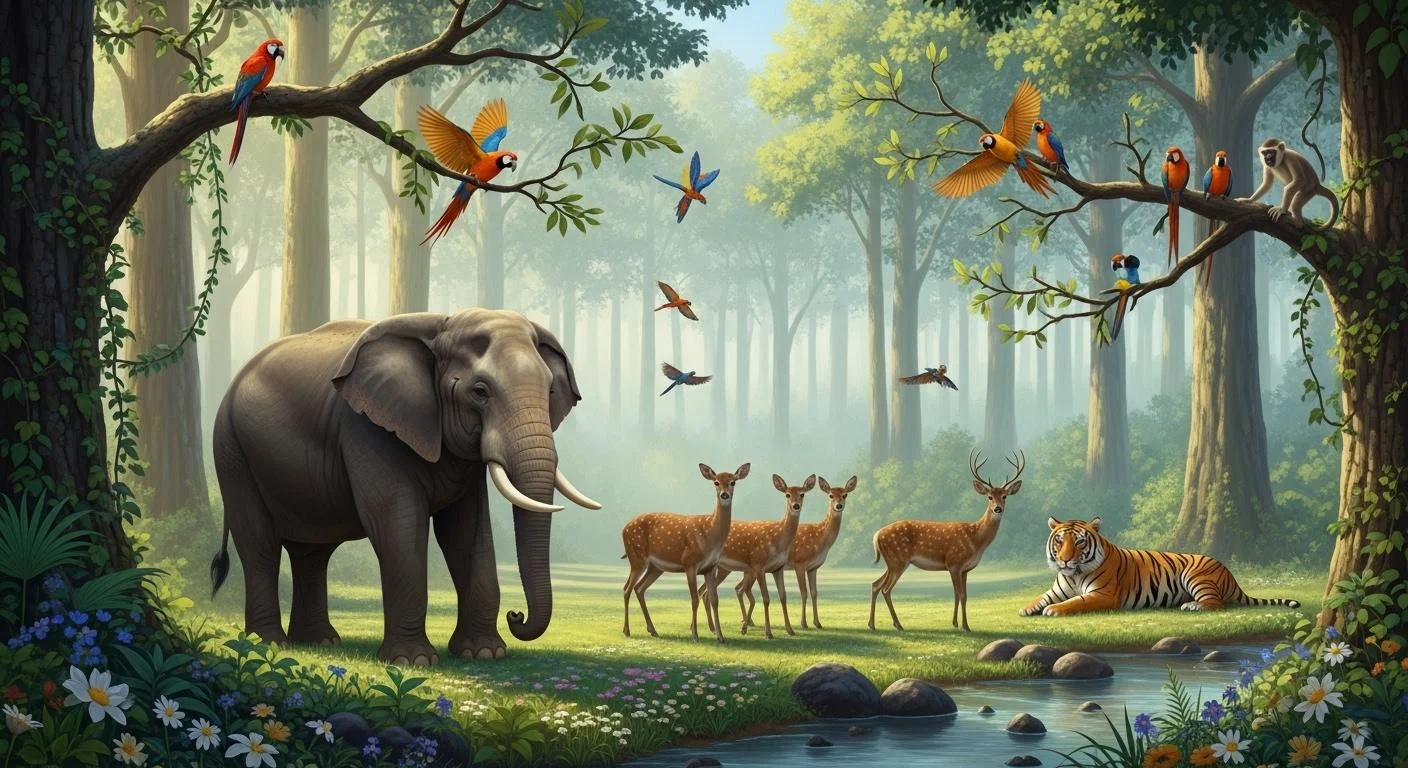
You open a window, a second of hesitation, no universal cacophony, some hear the wind, others catch the whistle of a bird, then the furtive buzzing of an insect crossing the light of March, hidden, fragile, this wildlife traverses all continents, and no, this March 3 does not become a pause in a busy schedule, this appointment is mainly to remind us of the urgency to defend an unavailable, inalienable heritage, which nourishes each morning that rises a little differently. As long as wildlife survives, life retains meaning, brilliance, movement, but if the line of March 3 is crossed, one day, something essential evaporates, then you read, you act, or not, but you no longer ignore the figures, the evidence, and the elementary gestures that change the game.
The origin and meaning of World Wildlife Day
Before any formal precision, a stop in New York, a General Assembly of the United Nations, which set a milestone in 2013, not just any milestone, a date, March 3, chosen to mark the adoption of the CITES Convention in 1973 in Washington, not a cosmetic whim, no, a text that outlines rules, that protects threatened species against a programmed disappearance by a commerce without conscience. The UN orchestrates, everyone follows or pretends to follow, once a year, international attention floats on animal and plant diversity, often ignored, often exploited, sometimes protected. Institutions, NGOs, anonymous individuals, or activists share a common point, a cause to defend, the preservation of wild species, and this appointment even helps those who cultivate the land to get closer to those who protect it, strange but necessary, the forced union of divergent interests.
A history inscribed in global commitment
The choice of March 3 is hardly improvised, this day discreetly invites itself into all environmental struggles and then resonates up to the top of institutions, it structures the calendar of NGOs, the rhythm of local associations, suddenly, the absorption of images, the strength of slogans, the debate arises, threatened biodiversity appears concretely. In 2024, digital innovation enters the game, technology slips into the defense of the living, hard to ignore, the annual themes capture attention, great apes, restoration of extinct species, year after year the subject reinvents itself, the urgency remains the same.
| Year | Slogan / Theme | Issue |
|---|---|---|
| 2023 | Partnerships for the conservation of wildlife and flora | Mobilization of local and global actors |
| 2024 | Connecting people and the planet, Exploring digital innovation | Digital and species preservation |
| 2025 | Restoring key species, Acting for resilience | Targeted protection of essential species |
| 2026 | Transcontinental solidarity for wildlife | Strengthened international cooperation |
The objectives and annual themes of World Wildlife Day
Sometimes, global ambition rubs against local dimension, sometimes the reverse, inform, alert, federate, the objective does not deviate, you must recognize the species around you, from the boreal lynx to the ferns of the Amazon, a few ignored gestures can tip ecosystems. Poaching, too discreet for some, silently decimates, illegal trafficking advances hidden, March 3 breaks down barriers, it exposes the reality to those who want to see, unveils hidden networks, gives a face to the missing, biodiversity has no tangible borders, it is enough to cross it mentally. Local action is not enough, states and NGOs propose solutions, strengthened laws, education for youth, action survives only if it breathes on the ground.
A ritual that never repeats itself
Nothing evolves out of habit, you notice the themes, innovative, sometimes unexpected, in 2025, the protection of key species focuses the debate, the following year, international solidarity takes over on planetary networks, there are no more passive spectators. Digital innovation jumps into the ring in 2024, artificial intelligence settles at the center of anti-poaching strategies, then you adjust your priorities, you re-examine your gestures, social perception tightens, awareness awakens. Future editions do not limit themselves to the obvious, they seek to scratch the automatism, to awaken the discussion, often, they succeed with brilliance.
International actions for the protection of wildlife
The impact is not limited to events, it takes root in reality, in daily life, the UN coordinates, CITES controls, monitors, between communication campaigns and actions on the ground, the commitment overflows borders, not everyone reacts at the same speed, but the global momentum asserts itself. African governments secure elephants by satellite, Japanese NGOs repair ravaged corals, on all continents the protective mesh grows, from one point to another on the globe, March 3 launches concrete programs, increased customs controls, big data summoned, strengthened logistical support, information exchanges under surveillance, everything accelerates. Kenya maps every movement of rhinoceroses in real time, Canada broadcasts podcasts in its schools about the fragile survival of large carnivores, these stories extend World Wildlife Day long after March 3, they anchor vigilance in habit rather than event.
Countries in action, revisited traditions
You read, some Indian villages decorate schools and improvise games where nature is hinted at, Germany, every March 3, broadcasts vast campaigns on its public television for the forests of Central Europe, Argentina? On social networks, videos circulate of children evoking the disappearance of jaguars, sometimes it is modest but it shakes certainties. In France, participatory monitoring platforms emerge from the shadows in 2026, sparking curiosity far beyond the initiated, the diversity of celebrations reflects a blossoming of initiatives, creativity triumphs over imitation, each culture appropriates this significant time, Gabon watches over its forests in its own way, Thailand imagines other rituals for its elephants. World Wildlife Day, or its equivalent, catalyzes citizen fervor, it surprises the inattentive observer.
The major challenges of living conservation
A moment of pause on the pitfalls, habitat fragmentation suffocates ecosystems, poaching restructures every year, escaping seemingly stricter laws, ivory and pangolin trafficking resists containment, and according to the International Union for Conservation of Nature, more than 28,000 species are under threat by 2026. Pollution, climate upheavals propel microclimates into the unknown, biodiversity pays the price, invasive species are added to the list, the Asian hornet undermines agricultural stability, World Wildlife Day reminds you tirelessly, every March 3, that nothing is obtained definitively, that no victory is irreversible.
Notable advances, but always fragile
The black does not invade the entire picture, the rise of surveillance drones reduces abuses, in Botswana, according to CITES, nearly 30% less poaching in certain territories since 2026, Australia tests connected sensors in its parks to save the most vulnerable. The European Union decides to double the area of its natural reserves by 2030, consensus prevails, but vigilance does not weaken, African countries finally synchronize their border policies, CITES praises the collective awakening, not everyone follows the same tempo, but no one ignores the urgency. Progress is grafted onto World Wildlife Day, innovation reignites solidarity, and it is no longer enough to watch the train pass, you must get on it, then you monitor, you listen, you adapt.
Individual means to act on World Wildlife Day
Everyone acts in their own measure, nothing is imposed, World Wildlife Day exists thanks to local energies, not just experts, you share a serious post about the leatherback turtle, you circulate a petition, you support a project, you sort your waste better, no dictatorship of the perfect gesture, but a momentum that shakes up routine.
- Share a validated educational resource
- Participate in a children's workshop on March 3
- Support an NGO according to your means, locally or remotely
- Initiate a discussion in your circle, professional or personal
Sometimes a single gesture, an unexpected discussion leads to awareness, the anecdote remains, the photo sent for the great global mural counts as much as the expert conference.
Official resources and partners on the ground
Transparency works in favor of involvement, you consult the CITES databases, you sift through the UN platforms, you seek advice from institutional guides, schools get involved, the media fill their files, exchanges grow, the emulation exceeds mere façade communication. Biodiversity actors commit to education, they transform March 3 into a decisive moment more than just an annual ritual, you feel it.
In a schoolyard, in spring, a girl in a floral blouse proudly explains to other students the difference between a leopard and a jaguar, her voice pierces the bursts of laughter, in the teachers' lounge, a teacher discreetly admits, Seeing the children reconstruct the food chain in class is probably the most beautiful result, far from speeches, close to the essential.
A shiver, a visceral need, seizes you when the evidence imposes itself, to preserve what can still be preserved, this March 3, starting point or milestone, offers you the possibility to act, a recurring global appointment, but little ceremonial, the next time you cross the gaze of a free animal or perceive the unusual silence of a forest, you may rethink the conversation initiated that day, what resolutions, discreet or visible, will be inscribed in your agenda?