You may have heard of December 18 in passing on an international agenda, but you sometimes overlook that this day discreetly disrupts the lives of over 420 million people worldwide. This is not a static commemoration nor an insignificant appointment, it is a true global recognition, a moment when the Arabic language asserts itself at the heart of living heritage and prompts you to consider its place in the world. Institutions, current events, and communities celebrate it tirelessly, since the integration of Arabic into the United Nations. World Arabic Language Day, an event that, since 2012, regularly rekindles collective curiosity, the strength of multilingualism, and the importance of a thriving heritage that is constantly reinventing itself, far beyond the expected horizon.
The context of World Arabic Language Day and the origin of December 18
A date chosen, immediate effect, December 18 effortlessly brings together a mosaic of native speakers, language lovers, teachers, and curious children. What ties this date to World Arabic Language Day to make it a global symbol? The answer lies in recent history, since 2012, when UNESCO designated this day to celebrate Arabic, in clear reference to a decision made at the United Nations in 1973.
Arabic then asserts itself in the very closed circle of the UN's official languages, joining English, Chinese, Spanish, French, and Russian. This recognition punctuates a long diplomatic journey to finally give Arabic a place commensurate with its spread and history. In the corridors of UNESCO in Paris or on the New York facades of the UN, December 18 proudly displays itself, attracting institutional debates, cultural tributes, and vibrant reminders, where diplomacy meets music, art, literature, not to mention a hint of shared daily life and heated debates on multilingualism.
The creation of World Arabic Language Day by UNESCO, milestones and scope
You do not choose a day at random, especially when it comes to December 18, which has become a timeless reference for the Arabic language on the world stage. The inclusion of Arabic among the six major languages of the UN has not resolved all equations; it has led diplomats, researchers, and political leaders to demand an annual celebration. You may have already encountered these round tables, these conferences on linguistic diversity, organized on the same day by UNESCO since 2012.
UNESCO amplifies this awareness by programming events and debates dedicated to the specific challenges of the Arabic language in institutions and the media. Voices from Africa, Asia, and Europe resonate, questioning, confronting, and sometimes agreeing on the necessity of preserving this plural and vibrant language in the great global melting pot. Arabic then asserts itself, no longer merely as a diplomatic attribute, but as a driving force of an embraced diversity, a dialogue between civilizations, where linguistic identity is constantly reinvented.
The history of the Arabic language, origins and trajectories of world heritage
| Period | Significant Event | Area of Spread |
|---|---|---|
| 7th, 8th centuries | Expansion of Arabic across the Arabian Peninsula and then throughout North Africa and the Middle East | Middle East, Maghreb |
| 9th century | Scientific Arabic shines in medicine, philosophy, astronomy | Baghdad, Cordoba, Cairo |
| 19th century | Cultural Renaissance (Nahda), modernization, and linguistic resistances | Egypt, Syria, Lebanon |
| 21st century | Arabic in the top 5 languages on the internet, vitality of Arabic-speaking media | Entire planet |
You stroll through history, traverse centuries and regions, and realize how the Arabic language transcends religious, political, or artistic boundaries. You hear it in the corridors of mosques, but also in university classrooms, on the bustling streets of Casablanca, or on the most innovative digital platforms.
From the Mediterranean to Africa, from medieval Spain to modern capitals, Arabic metamorphoses its face, enriching itself through intellectual exchanges, appropriating Greek philosophy, inventing algebra, and codifying medicine. And today, it explodes on social networks, pushing TikTok or Facebook to adapt their algorithms, and establishing new linguistic codes at the heart of global exchanges. The figures are eloquent; according to UNESCO, Arabic asserts itself in the top 5 spoken languages, while its digital dynamism leaves no one indifferent.
The goals and challenges of World Arabic Language Day today
In the face of this effervescence, what missions does World Arabic Language Day claim? You guess that promotion is just a facade; the real challenges lie in transmission, innovation, cultural resistance, and the permanent reinvention of social ties.
The missions at work on December 18
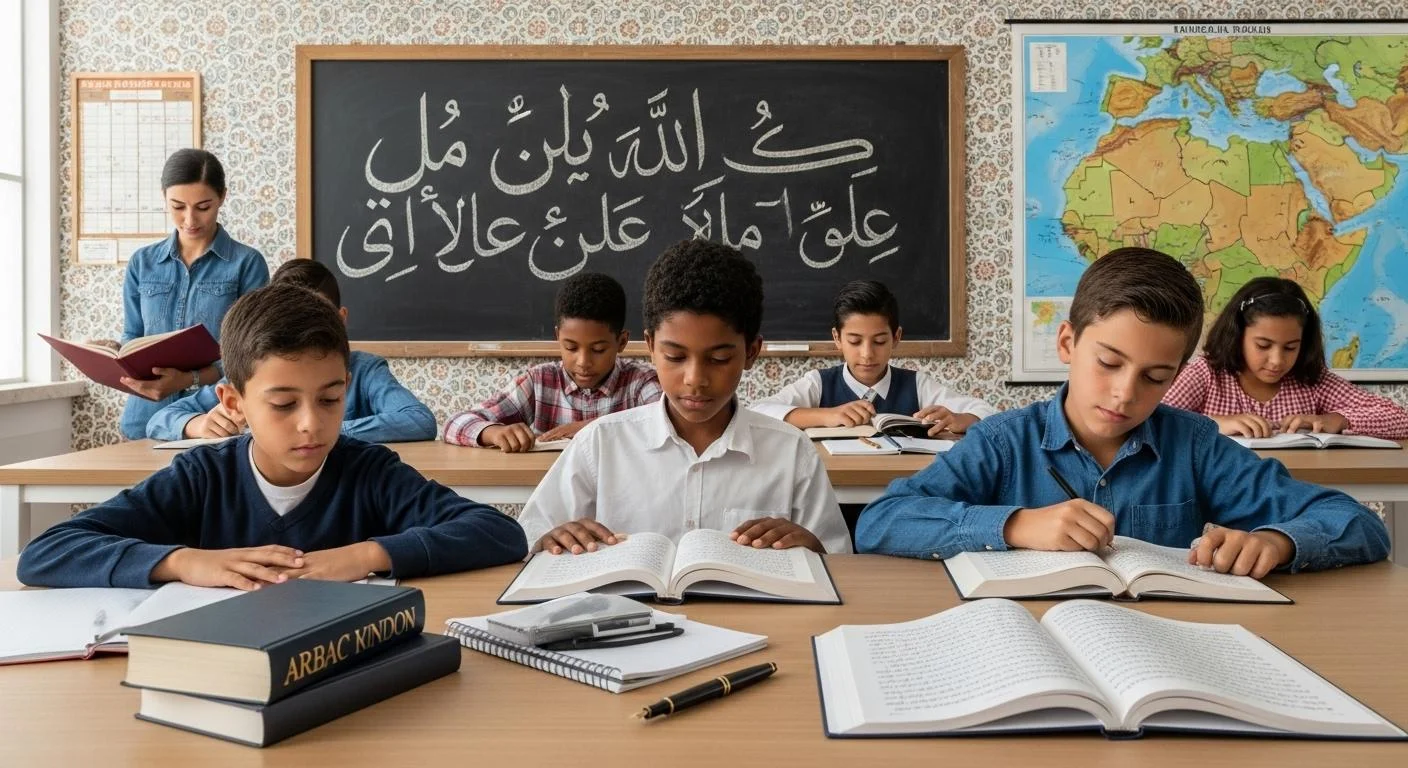
December 18 is invented as a meeting point to debate linguistic diversity, serving as a driving force in schools and cultural centers. Children, teachers, and artists discover new supports, new ways to question heritage and transmit sometimes forgotten traditions. The preservation of heritage no longer simply rhymes with memory; it is associated with valorization, dialogue, and innovation, wherever the Arabic language is expressed.
UNESCO makes it a banner in its recurring reports; valuing Arabic means revealing intercultural bridges, fostering mutual understanding and the growth of collective intelligence. Promotion, transmission, sharing, invention, these are the verbs that resonate during this event that current events always disrupt, enrich, or redirect.
The new challenges of the Arabic language in the digital age
| Context | Current Challenges | Opportunities |
|---|---|---|
| North Africa | Shortage of specialized teachers, pressures from foreign languages | Digitization of resources, new educational partnerships |
| Middle East | Diversity of dialects, lack of standardization | Growth of digital markets, new academic radiance |
| Europe | Persistent prejudices, limited access to higher education | Cultural intersections, strengthening of university exchanges |
Recent figures (Internet World Stats, 2025) show that Arabic asserts itself as the fourth most used language on the internet. Yet, challenges also weigh heavily on education and digital creation; you notice the lack of adapted educational resources, inequalities in Africa, and the imperfect integration of Arabic into technological innovations. But, paradoxically, digital Arabic stimulates a new generation of content, podcasts, videos, fiction, news, all driven by specialized hubs in Paris, Montreal, or Dubai.
The Arabic digital market is booming, diasporas create unprecedented bridges, and the dynamism of platforms translates into hundreds of billions of dollars in revenue; the World Bank estimates the Arabic-speaking digital market at nearly 200 billion by 2025. This is an unexpected cultural renaissance that redraws the geography of professional opportunities.
The celebrations and initiatives around December 18 and living languages
Engaging with World Arabic Language Day inevitably leads you to explore the diversity of initiatives, audiences, and modes of expression, sometimes delightful or moving, never expected, never monotonous.
The events organized during World Arabic Language Day on December 18, soon to be yours?
You enter a museum, stumble upon a calligraphy contest, read aloud during a poetry reading, and suddenly, the Arabic language seizes you. Teachers, students, enthusiasts, artists, writers, all intersect, discuss, invent, and deconstruct what you thought you knew about Arabic culture. Universities and cultural centers create, on that day, living laboratories of transmission. Nothing is static; everything breathes experience, encounter, and emotion.
Online platforms provide modules to learn the foundations of Arabic for free, museums and libraries disseminate manuscripts, videos, audiobooks. The celebration is not limited to the academic sphere; it overflows the walls and sometimes disrupts the course of daily life.
- Unprecedented exhibitions of rare manuscripts
- Participatory poetry readings
- Calligraphy contests for all ages
- Free interactive modules on the internet on the same day
The resources accessible in 2025 to explore the Arabic language
How to overcome your prejudices or truly discover the Arabic language? In 2025, the answer emerges everywhere where education opens up to digital. The British Council, France Éducation International, the Arab World Institute in Paris create flexible systems that transcend borders.
Looking for an app? On Google Play and Apple Store, Duolingo, Drops, and Babbel now adapt their modules to modern Arabic. Universities digitize ancient manuscripts, scientific databases, literary works, accessible with a simple click, and often for free, on December 18. Even Al Jazeera Learning and Arab Academy are included in official catalogs, offering training that did not exist just a few years ago. You have no more excuses; the diversity of resources has never been so vast.
A striking testimony, Rania, a high school student from Seine-Saint-Denis, admits just before presenting her poem at the annual event dedicated to the Arabic language, "I tremble, but pride prevails, because today, so many young people around the world tell their stories in Arabic. For me, this day rhymes with roots and openness to others, all at once."
When thousands of young people express their stories, it is no longer just the past they recount; it is a shared future that is being invented.
The place of the Arabic language in contemporary heritage and societies
Transmission does not stop at the borders of December 18; it irrigates science, literature, collective identity, and individual creativity.
The cultural and intellectual contributions of the Arabic language in today's world
Heir to foundational texts, the Arabic language has infused its treasures into all cultures for centuries. The tales of One Thousand and One Nights fascinate Tokyo, Buenos Aires, New York, and Dakar. But behind the myth, there are also scientific, architectural, and musical works that are rarely recognized at their true value.
Ibn Sina, Al-Khwarizmi, Khalil Gibran, Naguib Mahfouz, Mahmoud Darwich, all have contributed to making Arabic a vector of humanism and innovation. The manuscripts of the House of Wisdom, the legacy of Ibn Khaldoun, the novels translated into more than 60 languages testify to a flourishing that is still relevant today. The radiance, far superior to a mere commemoration, disrupts your perception of universal heritage.
The figures and institutions that mark the defense and promotion of the Arabic language
You sometimes encounter names that traverse continents and centuries, Mahmoud Darwich, a major poet invited to France, Nawal El Saadawi, a doctor and engaged author in Egypt, reminds an entire generation of the complexity of Arab identities. The Arabic language academies in Cairo, Damascus, and Amman publish updated dictionaries, recommendations, and valuable resources every year. The Organization of Islamic Cooperation, the European Union, and UNESCO regularly initiate debates on the standardization, dissemination, and future of Arabic. Diplomats, artists, and educators thus come together around a common will, that of seeing December 18 and its synonyms become a lever for openness, listening, and cultural renewal.
December 18 does not belong to any group; it brings together all those who dare to embark on the discovery or rediscovery of the Arabic language, sometimes with hesitation, often with passion. What will you take away from this World Day, a story, a melody, a word, perhaps a face? The next time, try to write a few lines, in Arabic or in your own language, and you will understand what it means to unite.