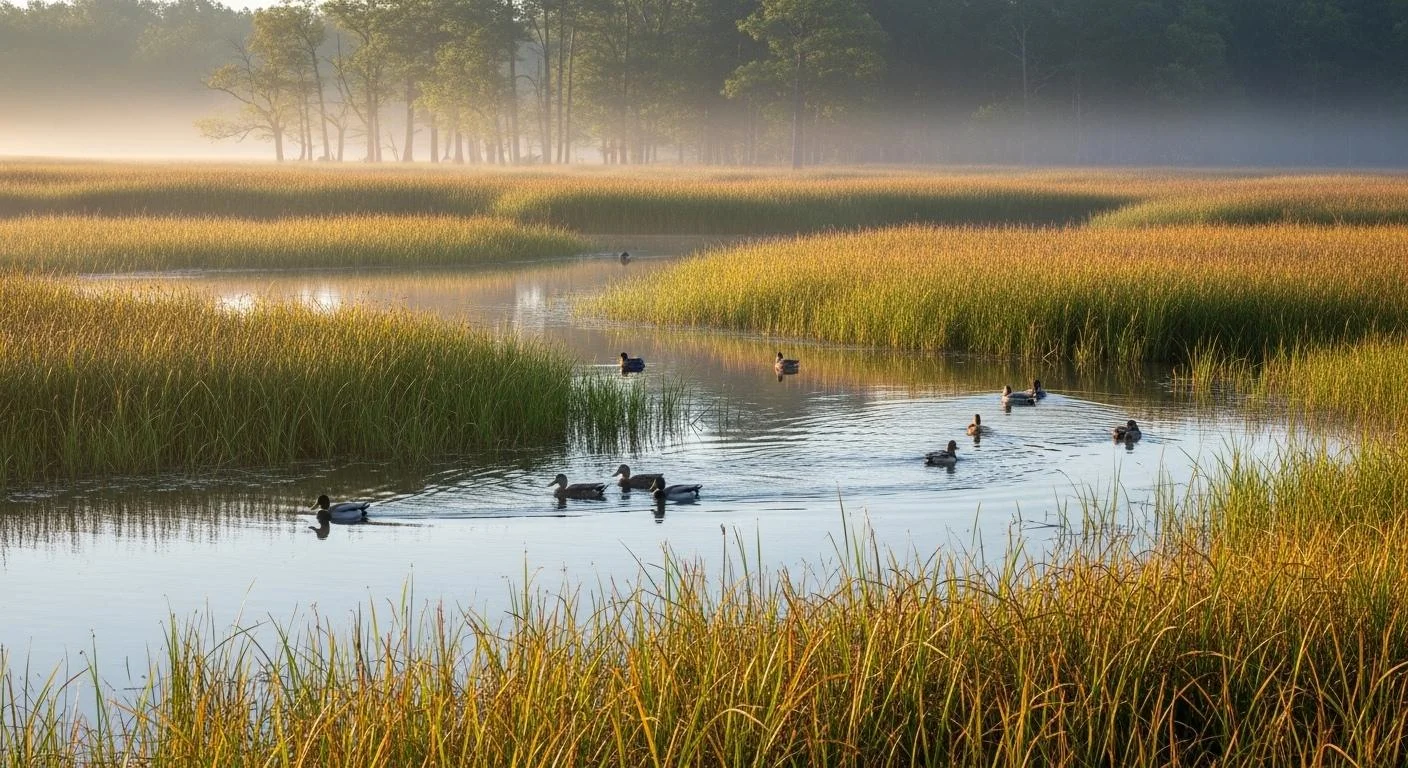
On February 2, the response comes without detour, immediate, before you, World Wetlands Day slips onto the agenda because we must preserve what remains alive, there, between land and water, there where diversity is still being invented. This is not a simple celebration; it is a persistent reminder, a fragile but essential compass for those still interested in the planet.
The significance of World Wetlands Day and its origin, why does this February 2 gather so much?
You move forward, sometimes with heavy boots, sometimes with a light spirit, but always surrounded by water, land, promises. This is no small matter, this moment that women, men, and children dedicate to a discreet miracle. A question arises, why does this February 2 attract so much attention everywhere in the world?
The year 1971, what does it evoke for you? The city of Ramsar, a puzzle of delegations, everyone tries to convince everyone. A treaty is signed, it has a name, Ramsar, a commitment that has become a myth, the foundation of a global movement. Since 1997, February 2 awakens this memory, the whole world renews the promise. The symbol does not weaken, World Wetlands Day infuses its strength everywhere, amplifying the universal recognition of these territories, a common future to defend, not just folklore.
Check, uncheck, that box matters, it is not just a posture. Actions are required. Promoting sustainable management, raising awareness of ecological importance, uniting citizens and decision-makers around the same cause, this is an unrootable thread of February 2. Every action cannot be contained in a slogan, every movement is based on data from CNRS, ONB, supporting evidence, protective environments, flood barriers, pillars of agriculture, ramparts against warming. On February 2, keep hope alive, start again, never let your guard down, you see more than a celebration, a real movement, a promise that begins anew.
The origin of the date February 2
No secret. Ramsar, February 2, 1971, a handful of hands, a treaty, a global story. 172 States join the ranks. The calendar now welcomes this appointment, France included, 52 labeled sites, and 3.7 million hectares protected. Did you not know? This treaty remains the only legal tool designed entirely for these spaces. UNESCO, often admiring, recalls this originality, the matrix of preserving exceptional natural assets.
The objectives of the international day
To raise awareness as widely as possible, across all ages, a clear red thread that connects visible missions and sometimes muted intentions. Responsible management intersects with pedagogy, public policies align or oppose, one thing remains: to make February 2 understandable to all. Climate change, pollution, scarcity, artificialization, the challenges are numerous. Messages are exported, regardless of language, age, or neighborhood, the stakes have no borders.
Wetlands, an ignored biological and ecological wealth?
The word intrigues, you really wonder what is hidden behind it. Wetland, marsh, mangrove, lagoon, yet nothing seems so obvious. Water decides, nature follows. Brenne, Camargue, Danube delta, Everglades, names, stories, climates, different rhythms but a common point: the tenuous balance, sometimes threatened.
Diversity spares neither France nor the globe, seasonal marshes, temperate peatlands, tropical mangroves. These environments are vital, but their space, their vegetation, their fauna, their vulnerability vary from one site to another. Where does a lake end, where does a pond begin, who decides if the dead arm of a river saves or condemns a species? A complex question, shifting answers.
| Type of wetland | Main characteristic | Major ecological role |
|---|---|---|
| Lake or pond | Large area of stagnant water | Regulation of local biodiversity |
| Marsh | Shallow waters, dense vegetation | Natural filtration of pollutants |
| Peatland | Accumulation of organic matter, water saturation | Storage of atmospheric carbon |
| Mangrove or delta | Mixed waters, abundant fauna | Storm buffer, animal refuge |
Scientists from ONB conclude, any body of water influencing flora or fauna falls into this large family, from the tiny swamp to the vast delta. On February 2, every year, reaffirms this value, half-visible, half-forgotten. Users, residents, visitors, each benefits, often in silence, from the invisible or unknown ecological functions.
The essential roles for biodiversity and climate
A pond, a simple mirror of a sky? No, never. Wetlands and water quality, direct connections! True sponges, these environments balance floods, retain, and release water serenely. 40% of animal and plant species, recorded by IPBES, evolve there, while these spaces occupy less than 3% of the terrestrial surface. Filtering pollutants, buffering erosion, hosting endangered species, naturally storing carbon, these are often ignored forces.
France has more than 2.4 million hectares still standing, not counting degraded lands or those in renewal. February 2 is not trivial. At this moment, everywhere, a collective momentum makes sense. Numerous actors, public or anonymous, act on all fronts.
The flagship actions of February 2, mobilization and collective animation in France and abroad
Winter awakens you, it lets nothing pass, energy breaks the torpor, and on February 2, no one remains indifferent. Reserves, classrooms, banks, lagoons, activity explodes everywhere. One day, everyone has a role to play. Educational walks, school posters, even elected officials get involved and debate the choices to be made, who would continue without this?
Exhibitions, workshops, restoration of flooded meadows, collective decontaminations, initiatives follow one another, carried by "I act for nature" or relayed by the Ministry of Ecological Transition. A whirlwind of actions, sometimes noisy, often silent, but all useful. The administration, citizens, NGOs, everyone participates, often side by side, never indifferent.
- Organization of eco-educational visits in the marshes
- Cleaning and restoration operations for floodable meadows
- Awareness through the dissemination of traveling exhibitions
« The children laughed, frogs caught under their fingers, then a heron flew away, silence imposed itself, some had never seen a wetland, at the end, questions pour in, curiosity never fades away », recounts Sébastien, an animator in Brenne. Perspectives change, a transmission takes place. No need for statistics, emotion is sometimes enough. These experiences are repeated, from one end of the country to the other.
The main actors in the mobilization for World Wetlands Day
| Stakeholder | Main mission | Territory of action |
|---|---|---|
| Ramsar Association France | Protection, awareness of labeled sites | All of France |
| Ministry of Ecological Transition | Political coordination and territorial support | National level |
| French Office for Biodiversity | Observation, technical and scientific expertise | Rural, urban territories |
| NGOs and local authorities | Field mobilization, participatory management | Regional, local |
Structures ensure the effectiveness of World Wetlands Day, networks that support every initiative, every useful action. On February 2, every year, resonates louder when these structures activate.
The current and future challenges surrounding the preservation of wetlands and the essential collective responsibility
Submerged marshes, concrete on the mud, the shock never leaves one indifferent. The erosion of life continues. 35% of wetlands erased from the map since 1970, the IPBES figure weighs heavily in the debate. Artificialization, drainage, agricultural pollution, dilution of management, missing tools, the threats are multiple, persistent, they will not go away by themselves.
Metropolitan France or not, land pressure, eutrophication, rising waters, everything accelerates. Climate crises make these spaces vulnerable, less resilient. Summer 2025 approaches, new droughts announced, the challenge never weakens. On February 2, an urgency beats, to protect the little that resists, to unite or to give up, do you hesitate? Not really, do you?
The levers of action to sustainably preserve wetlands
| Type of lever | Definition | Expected impact |
|---|---|---|
| Regulatory protection | Classification, usage restrictions | Effective protection of sites, preserved fauna and flora |
| Ecological restoration | Rehabilitation of degraded environments | Regained ecological functions, revived biodiversity |
| Citizen mobilization | Education, collective campaign | Consolidated local attachment, real involvement |
| International cooperation | Pooling of resources, know-how | Shared best practices, continuous adaptation |
When protection, restoration, education, cooperation align, society progresses. Regulation pushes to act for the common good. Education unleashes new energy, the spirit of mutual aid takes root. The 2025 edition, according to the first announcements, promises even stronger participation, driven by determined institutions, motivated volunteers, shared initiatives, and open minds.
Looking at February 2 arriving on the calendar, it is choosing without hesitation to defend the planet, but also to accept doubts, efforts, sincerity. Before the next appointment, the question remains, will you, too, take the step to preserve these wet environments?