On February 21, have you ever thought about those women and men who transform a simple visit into a memorable adventure? That day, International Tourist Guides Day reminds us of the irreplaceable place of those who embody the living memory of places. Without them, heritage remains silent, stories fade away. We do not listen, we look without understanding. In one sentence, February 21 invites us to reconsider the strength of the human behind every successful tourist experience.
The origin and impact of February 21, the story of a committed day
What does this date of February 21 really mean? A pretext, a coincidence of the calendar, or the culmination of a global recognition dynamic? Since 1990, the World Federation of Tourist Guide Associations (WFTGA) has been at the helm, uniting the sector's players. The choice of February 21 is not a lottery of scheduling; it is the desire to create a common moment for all guides in the world, a momentum just before the start of the high tourist season in many countries.
We are talking about a date that today brings together more than 70 countries. Cities in Europe and Asia, local networks in Brazil, actors from Quebec, everyone unites to remind the public of the fundamental role of cultural mediation. Recently, this event has also emerged in Africa and Oceania. Can you grasp the scale? More than hundreds of cities synchronize actions this week, not to mention the rising media attention. On February 21, guides do not just inform; they unite around a deep commitment to transmission and cultural openness.
The ambition of International Tourist Guides Day, a driver of global recognition?
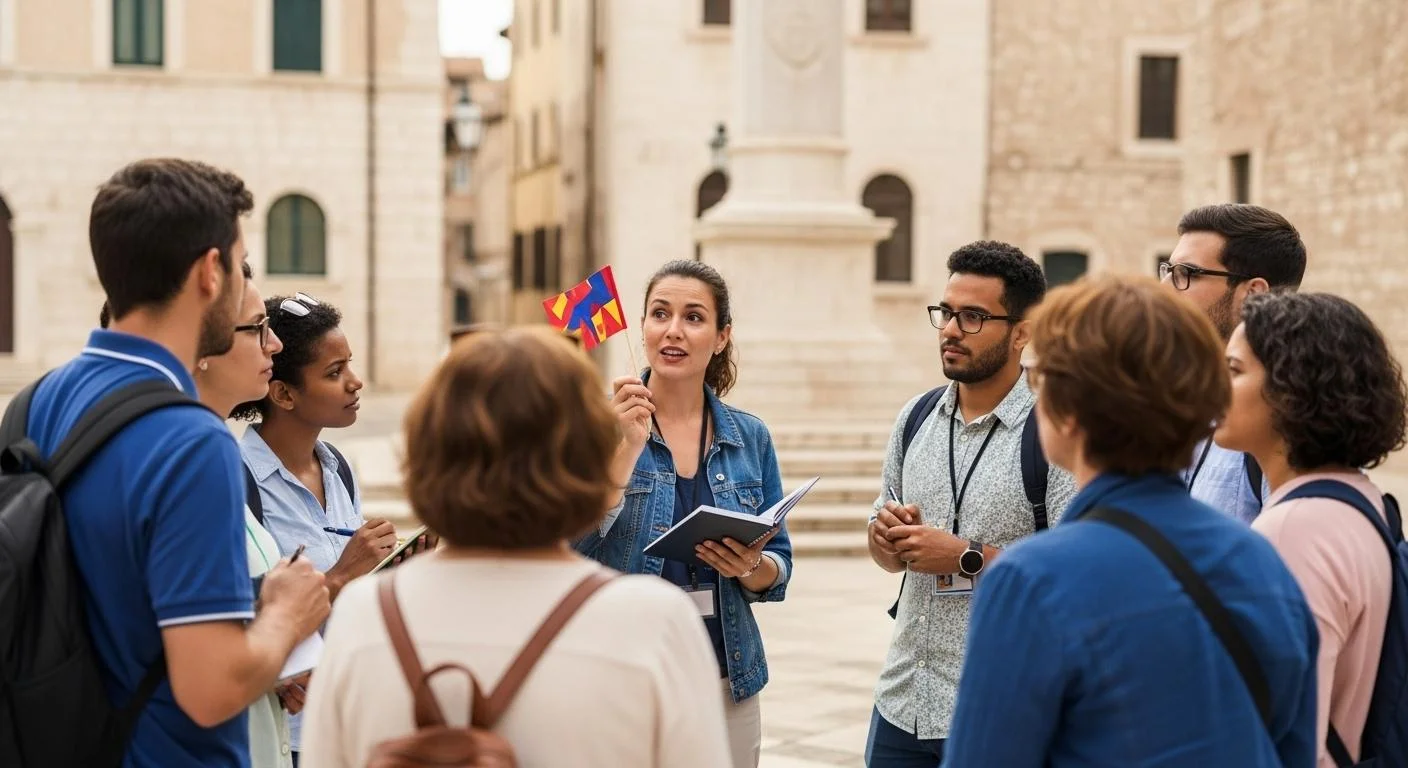
What is the meaning behind this annual meeting? Why the need for a unique date to value the profession? International Tourist Guides Day primarily serves as a tool for raising awareness about the pedagogical strength and technicality of an undervalued profession. Guides do not deliver an automatic narrative; they adjust in real-time, sometimes playing the mediator, sometimes the conductor, inspired by an unexpected audience or an unforeseen event that changes the group's dynamics.
Have you ever seen a guide juggling between five languages, two eager children, and a grandma passionate about Italian sculpture? Everything relies on a chain of skills that deserve institutional recognition, with long training periods, sometimes three or four years, and official certification. Let’s not forget cultural diversity: all continents benefit from valuing not only their guides but also their accents, languages, and local colors. On February 21, we hear the echo of the lands, the variety of what is whispered between two ancient stones.
The role of the tourist guide in enhancing heritage, an obvious fact on February 21?
Passing by the Reims Cathedral or in a street of Avignon, you sometimes perceive only a silhouette. Yet, the guide is the mediator who transforms a distracted group into a captivated audience. Their priority? To transmit knowledge, but also emotion, to create a link between different horizons. The audience never resembles itself; one must manage organization, unforeseen events, cultural differences, and sometimes even difficult access for a family. Nothing is left to chance.
Coming from the Louvre, Beijing, Granada, all guides develop a hybrid know-how, navigating between group management and improvisation. Some adapt the route session after session according to age, specific needs, and the general mood. You feel this difference at the end, bringing home more than just an anecdote, a real memory. Who has never remembered the little story forgotten in school books but told on site, in the right tone?
The requirements and training of the tourist guide profession, a journey, challenges
| Country | Average duration of training | Main requirements |
|---|---|---|
| France | 3 years (Professional License Guide-lecturer) | Official certification, mastery of at least 2 languages, practical internships |
| Italy | 2 to 3 years | Academic diploma, regional competition, evaluated oral presentations |
| Spain | 3 to 4 years | Bachelor's degree in tourism or history, regional accreditation, advanced language tests |
| United Kingdom | 2 years | Blue Badge, on-site evaluation, mandatory continuing education |
Did you think that the profession relied only on a good memory and a well-fitted suit? Think again. Guides often spend long years in training, sometimes until official certification in several languages. A good guide questions themselves, renews their content, adapts their approaches. Global demand pushes for excellence: knowledge of history, detailed geography, familiarity with art, and a keen sense of adaptation. With each new season, guides take ownership of the latest news, new circuits, and the renewed expectations of the public.
The events of February 21, a profession that invents itself live
Once a year, events multiply. Cities offer free tours, unique routes, immersive workshops for children. February 21 thus rhymes with openness, experimentation, and unexpected encounters. It is not just a simple parade of groups in museums; it is a time for reflection, transmission, and solidarity that transcends the usual boundaries of the sector.
The emblematic actions, what highlights for International Tourist Guides Day?
- More than 200 guided tours offered in 2025 in Quebec, according to Tourisme Montréal, a record mobilization
- Thematic conferences bringing together professionals and enthusiasts in several major European cities
- Workshops in schools providing access to heritage for young audiences and promoting artistic and historical education
Exchanges between guides invited from other regions stimulate unprecedented synergies each year. Schools willingly host discovery workshops. In entire neighborhoods, discussions about heritage, emerging professions, and social issues take place. Guides venture into digital experimentation, with hybrid routes, blending reality and virtual.With each edition, the vitality of the profession bursts into the open.
The impacts of International Tourist Guides Day, visible effects?
| Effect | Description | 2025 Data |
|---|---|---|
| Increased visibility | Growth in bookings after the events | +15% in bookings according to UNESCO |
| Local partnerships | Creation of new links between guides and operators | One hundred agreements signed in Europe source WFTGA |
| Highlighting atypical circuits | Development of offers outside of classic flows | 26 local networks created in France in 2025 source Ministry of Tourism |
| Increased solidarity | Mobilization around access to continuing education | National federations engaged on this front |
The sector observes a clear resurgence of notoriety from the end of February. French guides report, according to the Ministry of Tourism, a visible increase in attendance on new circuits, sometimes off the beaten path. More than one local network in two claims to have created unique offers thanks to International Tourist Guides Day. Collaboration intensifies, weaving a web of sectoral solidarity. Some regions see attendance rise by up to 20%, proof that highlighting the profession acts as a revealer.
The future of the profession, what lies ahead after February 21?
Grounding on the field is no longer enough; the profession is spreading its digital wings. Guides explore virtual reality, initiate augmented visits, produce podcasts, and immersive content. The public is changing; they want interactivity, sensitivity, and customization. Do you still believe that the profession risks standardization? It is quite the opposite. Innovation and specialization take over; each guide refines their themes, personalizes their approach, invents new formats. The energy of a group in front of a screen and in front of a statue is never the same, but curiosity is shared in both cases.
Initiatives that extend the dynamic all year round, beyond the simple event
International Tourist Guides Day acts as a trigger. Professional networks take over: in 2025, France counts 35 regional networks, creating spaces for mutual aid, discussion, and continuing education. Schools develop partnerships, inviting guides to raise students' awareness of history and cultural mediation. Professionals also create their own digital routes or launch their podcasts, weaving a lasting link with visitors. Action extends without calendar constraints. We meet guides on social networks, listen to their anecdotes, and learn to decipher a work thanks to them, well beyond the initial visit.
« Everything changes the day a student whispers to me at the end of a guided tour, eyes shining: “I will never forget the story of this statue that you told us.” Time stops, fatigue fades away. Nothing compares to this feeling, this direct gratitude. This profession moves you as much as it transforms you, » testifies Sonia L, guide lecturer for twelve years in Toulouse.
Ultimately, February 21 is not just a seasonal news event. International Tourist Guides Day invites gratitude, attention, and renewed curiosity. During your next trip or just down the street, will you listen differently to the guide's voice? Is it not there, in the slight silence of a captivated group, that the most beautiful score of heritage transmission is written?