Here you are faced with a question that no one should evade, because February 27 does not fade away, it imposes itself, it screams the fragility of the Arctic wherever a bit of frost remains. Anyone who hears about this date is already doing more than just enduring; they are taking a stand. This February 27 is the unavoidable reminder, the symbol that, even on the most distracted networks, resonates like a spotlight on this giant of the ice, the polar bear. International Polar Bear Day forces awareness and transforms you from a mere spectator to a concerned witness, a potential actor, not just a reader who closes the story once the date has passed.
The significance of International Polar Bear Day, a universal symbol of alertness and commitment
We must return to it, because this famous International Polar Bear Day has emerged every February 27 since the early 2000s. Scientific voices, NGOs, a few scattered biologists, a whole network is active from one continent to another, and the American organization Polar Bears International steps up, supported by WWF and the International Union for Conservation of Nature. Do you feel the urgency? It is not just a date on a calendar, but a bridge between public debates, the political world, and a crowd that feels, slowly, concerned.
Certainly, the UN did not bend under pressure, no official day, but the echo is growing. We no longer simply find a wink directed at the cause of Arctic mammals; we understand that this February 27 now crystallizes the fight to preserve an entire ecosystem. Alerts are blooming, campaigns are following one another, mobilization transcends borders, and meanwhile, the reader wonders, rightly so. The mere act of remembering this day, of sharing it, suddenly shifts the cursor of biodiversity into the public sphere.
The origin of this day, what motivations prevail, why does February 27 establish itself everywhere?
Have you already seen the campaigns from WWF or Greenpeace this week? Impossible to ignore this media uproar, this commotion that exceeds the scientific sphere, landing on the desks of schoolchildren, in the waiting room of a medical office, or on the most ordinary Instagram feed. The date imposes itself, structures debates that once bordered on general indifference. Strange feeling to see a species crystallize the fear of losing everything, right? And then, there is this serious question left hanging: what good is a banner "International Polar Bear Day" if no one moves?
The stakes of protection, what real urgency for the polar bear?
The challenges do not wait, they hit hard, they force us to face the truth. The IPCC will update it in 2025, warming accelerates, the ice shrinks visibly, no one is mistaken. The habitat of the white predator shrinks, simply, its hunting grounds are fragmented, reproduction is slipping into precariousness. The picture cools, life cycles collapse, the food balance of the pole wobbles. Do you think the conflict stops there? Pollution, oil exploitation, human invasion, toxic ingredients in the recipe for decline.
We are not just talking about hungry big bears, but a domino effect: if the polar bear drops out, the entire biodiversity collapses alongside it. The figures freeze the most optimistic: the Arctic is warming four times faster than the rest of the globe over the past 30 years. In the face of precariousness, silence settles, glaciers lose their voice, and the White Bear, this silent colossus, floats on an island that shrinks ever more.
The portrait of the polar bear, vulnerability and adaptation of a fascinating giant
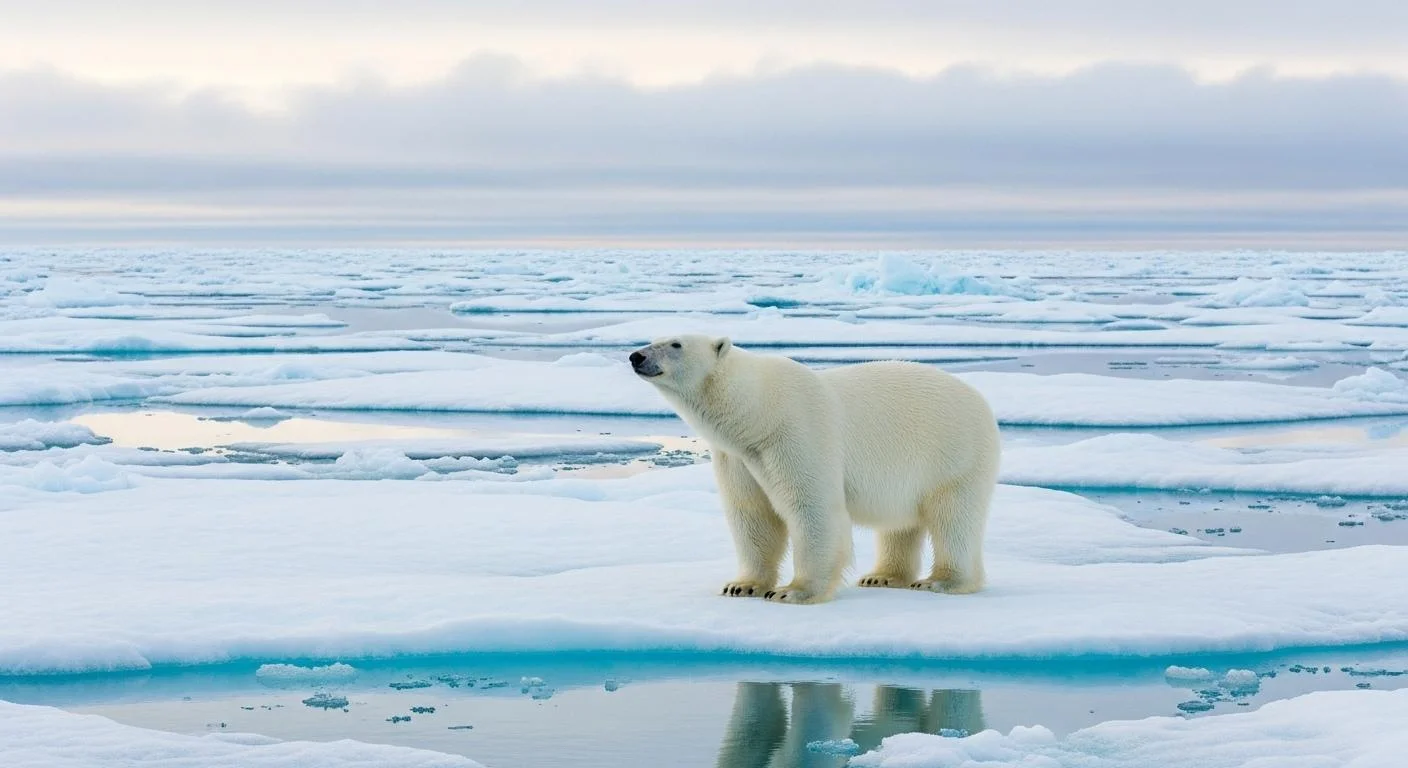
The polar bear weighs not only by its mass but by what it embodies in our collective imagination. You see it on the ice, thick fur, dark skin beneath the white, a silhouette of 2.5 to 3 meters standing, nothing else impresses as much in this frozen territory. Who, once, has not admired this silhouette facing the North wind? This is not folklore; it is the reality of extreme survival, one that demands energy down to the last muscle fiber.
| Polar Bear | Brown Bear | Arctic Fox |
|---|---|---|
| Thick white fur, black skin, 2.5 to 3 meters tall | Variable brown fur, smaller size, more massive | White or gray fur, very small size (30-40 cm) |
| Predator, seal hunter thanks to a developed sense of smell | Omnivore, eats fruits, plants, and sometimes small animals | Opportunistic carnivore, rodents, birds, fish |
| Life cycle, litters of 1 to 3 cubs, delayed gestation | Annual or biennial litters, 1 to 4 cubs | 6 young per litter, rapid reproduction |
The polar bear can go several days without eating, wandering on the ice, sniffing for an elusive prey when the ice is unstable. Its diet depends on the solidity of the ice; everything collapses otherwise. The survival of the young is played out by the minute, mothers draw from resources that only Arctic species can imagine, and mortality explodes when the ice cracks too early. Life cycles blur, nature adjusts its rules, often in the wrong direction.
The situation of polar bears in the world in 2025, should we panic or hope?
No question of minimizing the state of the global population. It is estimated that between 22,000 and 26,000 individuals roam in 19 groups, from Alaska to Novaya Zemlya, way up where we hardly ever go. The Arctic is home to all of these bears; it cannot be invented. According to the data from 2025, the big bell tolls over Hudson Bay: the melting of the ice is exploding, bears are migrating unexpectedly, reproduction is faltering, food is lacking.
Entire regions are sounding the alarm: Western Greenland, James Bay, the Laptev Sea. Experts monitor birth rate indicators; the slightest alert tips the balance. February 27 acts, this year again, as a reminder that crosses borders and rekindles the flame of ecological mobilization.
Awareness and protection actions on February 27, how to be useful without revolutionizing everything?
Campaigns, debates, efforts are not lacking. The anecdote of a hairdresser in Lyon, suspended from a garland of white bears, illustrates it to the end of the scissors: "I suggested to my clients to turn off the light at their station during a haircut, just to mark the occasion. Sometimes, a modest gesture speaks more than a long speech." A smile, a memory, a spark, perhaps the trigger? Far from the image of a radical activist, this day brings together the discreet, the curious, the skeptical, all at least a little touched by the cause.
- Supporting a campaign with WWF or dedicated associations triggers concrete results on the ground
- Participating in educational events, workshops, or challenges in local life
- Raising awareness among your circle by sharing articles
- Reducing energy consumption, preferring gentle travel
When you share a post on social networks, turn off your heating, or choose green electricity, you are not just settling for a symbol; you become one of the links in this solidarity chain. Hashtags, family photos, educational quizzes, online conferences, everything transforms on that day. Greenland, Norilsk, Svalbard, even Paris or Helsinki, organize discussions, workshops, suspenseful moments where everyone, in their own way, connects to this cause. International Polar Bear Day propels the voice of citizens as high as the pole allows.
Perspectives for the future of the polar bear and its environment, what scenarios on the horizon?
We ask ourselves the question every winter, what comes next, for whom, with what resources? February 27 is also the day when laboratories and researchers unveil data, confront hypotheses and results. No one is looking for the miracle recipe, but you may feel the shift at work. MOSAiC, an international program, GPS beacons on bears, tracks their movements, targets critical areas, exposes the blind spots of science.
| Program | Scope | Results 2025 |
|---|---|---|
| MOSAiC Project | Central Arctic | Precise tracking of movements, modeling of melting |
| WWF Polar Bear | Canada, Russia, Norway | Dating of marked individuals, tracking of pregnant females |
| IUCN Cryosphere Initiative | Arctic territories | 10 percent progress in anti-poaching campaigns |
The integration of genetic telemetry refines the knowledge of family structures, and through all this, International Polar Bear Day serves as a living platform to outline, step by step, the state of research and action.
Future stakes, vigilance and solidarity or fatalism, where is the boundary?
For 2025, a question arises everywhere, urgent, burning: who will make the courageous decisions to slow the melting, to regulate hunting, to limit the effects of the oil industry on the most threatened territories? On February 27, figures, photos, testimonies spread, shaking collective apathy. It remains to be seen who will move from the status of spectator to that of actor, humble or loud, each in their own way.
So, next year, when International Polar Bear Day comes knocking at your media door, will you let yourself be carried away, or will you repeat the silence of an ice sheet cracking under an indifferent sky? No need to be a biologist, explorer, politician, or opinion leader; sometimes, a few gestures count more than grand speeches.