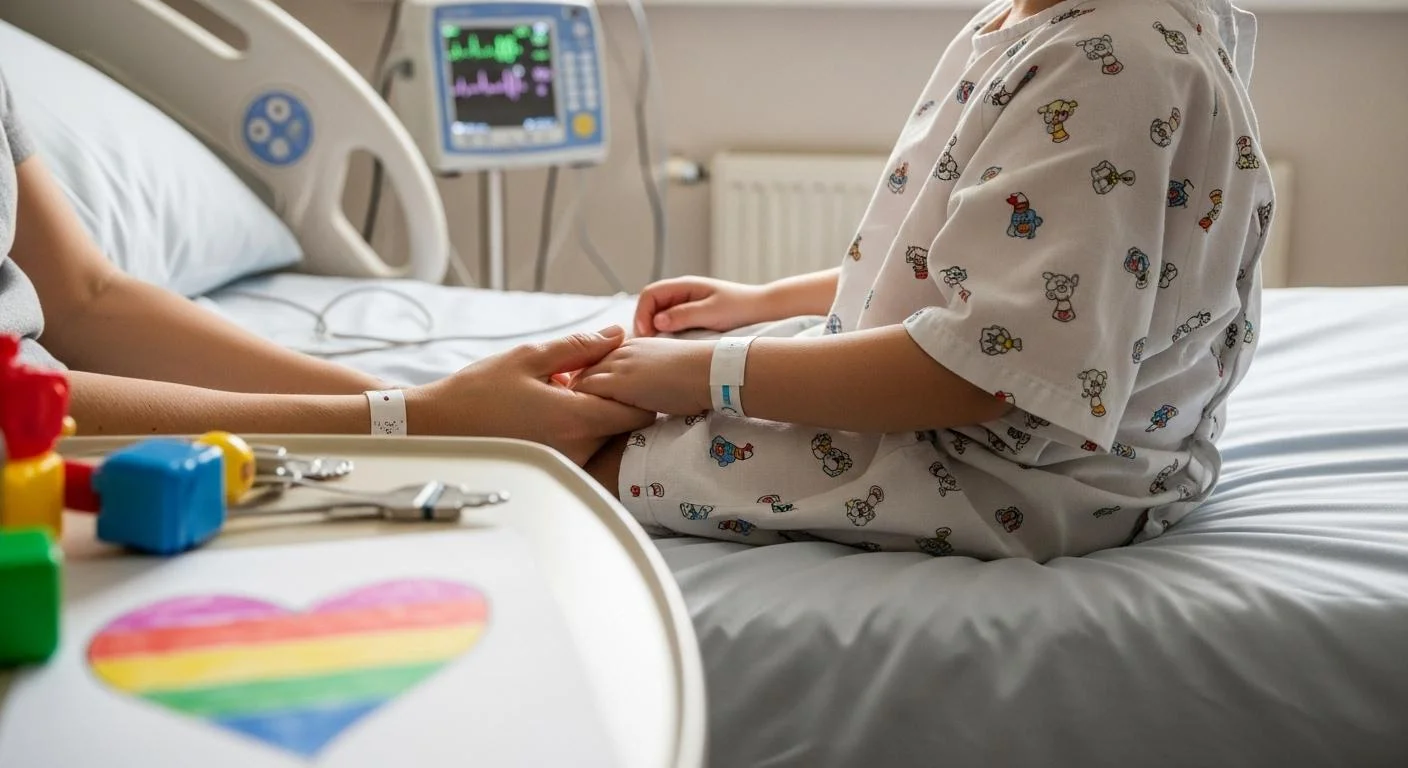
February 14 is not just about sweets and bright symbols in shop windows, not this time; congenital heart defects remind everyone that this day also rhymes with mobilization, education, and solidarity in the face of a medical reality that leaves no one indifferent. You may come across this term and furrow your brow; International Congenital Heart Defects Awareness Day imposes itself each year with its force of calling and its impact on the lives of thousands of children and adults. It shakes, it questions, it never overlooks the urgency of the numbers and the weight of emotions, you can feel it from the first words, can't you?
The global context of International Congenital Heart Defects Awareness Day, why does February 14 really matter?
The excitement of February 14 is not limited to lovers; the news has broadened for over 25 years thanks to International Congenital Heart Defects Awareness Day. A movement was born at the very end of the century, 1999 remains in memory; associations, NGOs, hospitals, everything converges to shake consciences in the face of a scourge that persists from birth.
The origins and objectives of International Congenital Heart Defects Awareness Day, what reason lies behind this mobilization?
Sometimes you wonder why this day, why talk about it? The momentum mainly comes from meetings between families and associations, it has spread through the World Heart Federation, supported by the French Federation of Cardiology, the Congenital Heart Public Health Consortium, relayed by the National Heart Council. The objective seems simple, it is never: to raise awareness, open the discussion on the importance of screening, bring forth information where silence weighed down the atmosphere.
Statistics prove it, in 2025, campaigns conducted on this fateful date lead to a 22% increase in early screening procedures; the media take it up, the streets are adorned with posters. The feeling of belonging to something collective persists, even in the anonymity of a waiting room. February 14, a disrupted routine, a breath of alert, it does not go unnoticed. Do you see that poster in your pharmacy mentioning the unknown childhood risk?
The global figures and disparities, do February 14 and the reality of the numbers frighten?
The data does not spare, it awakens. One million three hundred fifty thousand births affected each year, the World Health Organization does not minimize. In Africa, the harshness strikes: a mortality rate exceeding 60% in the absence of appropriate care, while in Europe, 40 years of life gained thanks to early screening and surgery. Stark inequalities are also found in Central Asia where only 7% of children benefit from adequate medical follow-up.
| Continent | Annual Prevalence | Mortality Rate | Major Initiatives |
|---|---|---|---|
| Europe | 12 per 1000 births | 5% | Systematic neonatal screening since 2019 |
| North America | 10 per 1000 births | 4% | ACC recommendations, public campaigns |
| Africa | 8 per 1000 births | 60% | NGO and hospital partnerships |
| Asia | 7 per 1000 births | 14% | Pilot prenatal screening projects |
Medical advancements are breaking through, but the fracture still persists. The gaps between North and South burst the screen, even on February 14. The emotional impact of this day resonates universally, reminding everyone that one in a hundred births changes everything.
Congenital heart defects, what causes, what faces?
There are several reasons to mobilize, but one must also know what these heart defects really are. We talk a lot, we sometimes generalize, but the reality proves to be much more complex.
An accessible medical explanation, what do congenital heart defects encompass?
This set of disorders intrigues, fascinates, or worries, it's hard to remain neutral. A tiny anomaly in the development of the fetal heart is enough to dismiss all hope of a simple life, at least at the beginning. The main defects sneak into the wall, into the valves, or insinuate themselves into the major vessels. You then hear about murmurs, cyanosis, or a murmur heard through the stethoscope, and suddenly, everything changes.
Some forms go unnoticed for years, while others impose themselves from the first days. Destiny oscillates according to the degree of severity; some children are content with monitoring, while others undergo the burden of surgery barely after birth.
The causes and risk factors, where do these congenital heart defects arise?
Legitimate question, plural answer. Heredity enters the arena, weighing 30% in the balance according to the latest data. Genetic mutations, Down syndrome, rubella during pregnancy – nothing is trivial. Toxic substances, whether medical or related to alcohol or tobacco, further burden the accounts.
Environmental dangers add their stone to an already fragile edifice; society monitors, advises, sometimes alerts on precautions to take at the beginning of pregnancy. Medical vigilance increases, but prevention hits its limits when fate intervenes.
The major families of congenital heart defects, what manifestations, what symptoms?
There is not one unique form; there is a whole palette. Interatrial or interventricular communication is often found, manifestations generally evolve benignly, but there are cases where aortic coarctation or transposition of the great vessels requires urgent treatment.
Signs vary from disarming fatigue to a bluish coloration of the lips, passing through shortness of breath during exertion or a murmur perceived by the doctor. INSERM indicates that in 15% of cases, the diagnosis sometimes drags on until adolescence. The age of diagnosis often conditions the severity of the prognosis; a delay is enough to disrupt years of potential.
The medical and human journeys, how does society support those affected?
The story does not stop at the discovery of an anomaly. It is about comprehensive care, with shifting contours, marked by mixed anxieties and hopes.
Screening for congenital heart defects, what tools to change lives?
Medical innovation disrupts perspectives. Prenatal cardiac ultrasound today reveals more than 70% of malformations, according to the French Society of Cardiology. At birth, the double listening performed by the pediatrician and the mandatory oximetry in 18 European countries changes the fate of a large part of newborns.
Even complex cases benefit from more accessible scans or MRIs. Early access to effective diagnosis transforms the trajectory of a baby and, therefore, an entire family; this is observed every year in specialized services.
Therapeutic solutions and follow-up, how does medicine respond today?
Open-heart surgery regularly imposes itself in the first weeks in France since 2012. With a survival rate of 83%, the repair offers a nearly normal school and social life to the vast majority of operated children.
This obviously requires annual follow-up, therapeutic adjustments, and unwavering psychological support. Some children depend on a pacemaker or an artificial valve, but gradually find their place, proud to live a life that medicine has saved.
The events and voices, what concrete impact on February 14?
February 14 changes the agenda of hospitals and associations. An energy leads to organizing conferences, workshops, fundraising, or activities for hospitalized children. In Paris, Lille, or Bordeaux, the corridors are adorned with ribbons, brochures are distributed, families united under the banner of solidarity. The French Federation of Cardiology highlights a 35% increase in participation in 2025, proof of the need for information and listening.
- Interactive conferences and webinars open to all
- Activities in hospitals, educational workshops, and exhibitions
- Fundraising and launching local initiatives to support research
- Campaigns on social networks and strong media relays
The movement does not stop there; it also reaches Canada, the United States, or India, where solidarity runs, sports challenges, and sharing stories immerse everyone in the same combat momentum.
A testimony, a face behind the statistic
Lucas holds his mother's hand in anticipation, three months, the light of the operating room, the surgeon reassures: “He will be fine.” After the operation, Lucas lives with a mechanical valve. At school, he explains his scar, without fear, he smiles: “My friends think I'm a robot.” His mother describes the sleepless nights, the solidarity between families, the comfort of the support group.
Lucas's story reminds us of the discretion of victories, the power of resilience, the invisible strength that binds all affected families.
In 2025, International Congenital Heart Defects Awareness Day is not just a formality. You have encountered the statistics, you have discovered the faces, you understand that the challenge is collective. The real question: will you let indifference pass, or will you let your own heart resonate, even just once a year?
Sources, World Health Organization, INSERM, French Federation of Cardiology, Congenital Heart Public Health Consortium, World Heart Federation, National Heart Council.