February 15 has been prominent in the news since 2002, impossible to ignore this date that suddenly brings to light the daily reality of thousands of families. You hear about solidarity, global campaigns, and unequal treatments, and we respond with a clear rallying cry: we never give up against pediatric cancers. The impact, year after year, International Childhood Cancer Day resonates universally.
International Childhood Cancer Day and its shared meaning
You may wonder who put February 15 on everyone's lips? No one pulls this date out of a hat; it is indeed the common cry of parents and doctors, united within SIOP, supported by Childhood Cancer International. Since 2002, this mobilization has not weakened; every association, every hospital department puts up posters, displays golden ribbons, and organizes challenges. It is not a sadly commemorated anniversary but a rallying point that breaks the silence and gives breath to resistance.
The creation of a global mobilization, why this day?
A collective, some doctors, a few parents, and February 15 becomes essential; try to grasp the randomness, it does not exist. This day unites actions, capitalizes on the need for unity and visibility. Gradually, 90 countries follow, then 117, thanks to major NGOs. It is not a bookmark on the calendar but a displayed necessity, everywhere, without time zone or language delay, February 15 becomes impossible to bypass, as it awakens society to the urgency of the situation.
The global scale of a movement, what actions are multiplying?
Have you noticed the wave that crashes on social media every February 15? Sporting challenges call for solidarity, cities buzz with marathons, schools shake up the usual rhythm, gold is worn in the hallways. And then, the media echo, amplify, relay, International Childhood Cancer Day sounds like a collective outcry. In 2025, over 1800 reports will broadcast the message of hope, social networks fuel videos and testimonies that touch where it hurts, but where mobilization becomes contagious. It is hard to remain indifferent in the face of this shared energy that breaks isolation and reconnects families, caregivers, and citizens.
Pediatric cancers, so unlike those in adults
It is impossible to generalize, especially impossible to mix everything up. The diseases of children and those of adults, the gap remains immense, and the numbers confirm it, nearly 60 forms of childhood cancers, each with its fractures, its stakes.
The major families of tumors, what realities are hidden?
Did you think leukemia attracted all the attention? Yes, it weighs heavily in the statistics, 30% of childhood diagnoses, according to INCa, closely followed by brain tumors (25%) and lymphomas (10%). The rest, more discreet, sometimes worries more, sarcomas, neuroblastomas, bone tumors carry grim prognoses. Europe records about 35,000 new diagnoses per year, globally, there are 400,000 families thrust into the battle, according to the World Health Organization.
The state of affairs in France and around the world
So what do the numbers say? 2500 new annual cases detected in France according to INSERM, survival rates are improving, but not at the same pace everywhere. In Western Europe, 82% of children survive beyond five years, a remarkable leap, but fragile elsewhere. Central America and Africa drop below 40%. The gap shocks, revolts, but galvanizes; while mortality has decreased over the last twenty years, the reality offers little respite; a diagnosis always upends an entire life. You walk through the corridors of a hospital department, you sense the gravity, you hear the weight of silences as much as the energy of a staff that never gives up.
Scientific advances and the race against time
Science has tackled the specificity of cancers in those under 18 since the 2000s. You read a new term every week: immunotherapy, gene therapy, targeted treatments; these innovations are no longer experimental; they challenge certainties and evolve care.
Medical progress, what hope for tomorrow?
Have you heard about clinical trials that raise the survival rate to 90% for acute lymphoblastic leukemia? Europe is leading the race, France is experimenting with personalized strategies. The SIOP Congress in Ottawa in 2024 hammered this home: without international alliances, there is no progress, no lasting discoveries. The advances do not only help find the right treatment; they pave the way for follow-up, a quality of life that was thought unattainable. However, this scientific leap does not reach all families, all countries. Progress lags, bogs down, stops at the borders of inequalities.
The on-ground actors, who leads the mobilization on February 15?
The UNAPECLE association, the Gustave Roussy Foundation, Imagine for Margo, caregivers, and volunteers on the ground, so many faces behind each collection, each challenge. They are the ones who bring International Childhood Cancer Day out of the hospital, who transport it to colleges, markets, and the words of social networks. Donations exceed 5 million euros collected in France in 2024. International NGOs double their efforts to support families, fund research, and distribute treatments where they are sorely lacking. February 15 echoes, tangible mobilization, quantified solidarity, human connection, nothing abstract.
Access to care, what disparities by region?
| Region | 5-year survival (%) | Access to innovative therapies | Main challenges |
|---|---|---|---|
| France/Western Europe | 82 | Very high | Inequalities by geographical area |
| Eastern Europe | 65 | Medium | Medical desert, availability of medications |
| Latin America | 55 | Low to medium | Hospital infrastructure, diagnostic delays |
| Sub-Saharan Africa | 20-40 | Low | Resource shortages, access to care |
Look at the data, the gap persists; each country does not start from the same point, nor the same hope. Accessing innovative therapies remains a colossal challenge in resource-poor regions, where too often, the question of medication still arises as a luxury. Associations call on governments; the 2030 objective makes sense, to reduce these glaring inequalities through campaigns and projects.
Commitment and awareness, the true wave of February 15
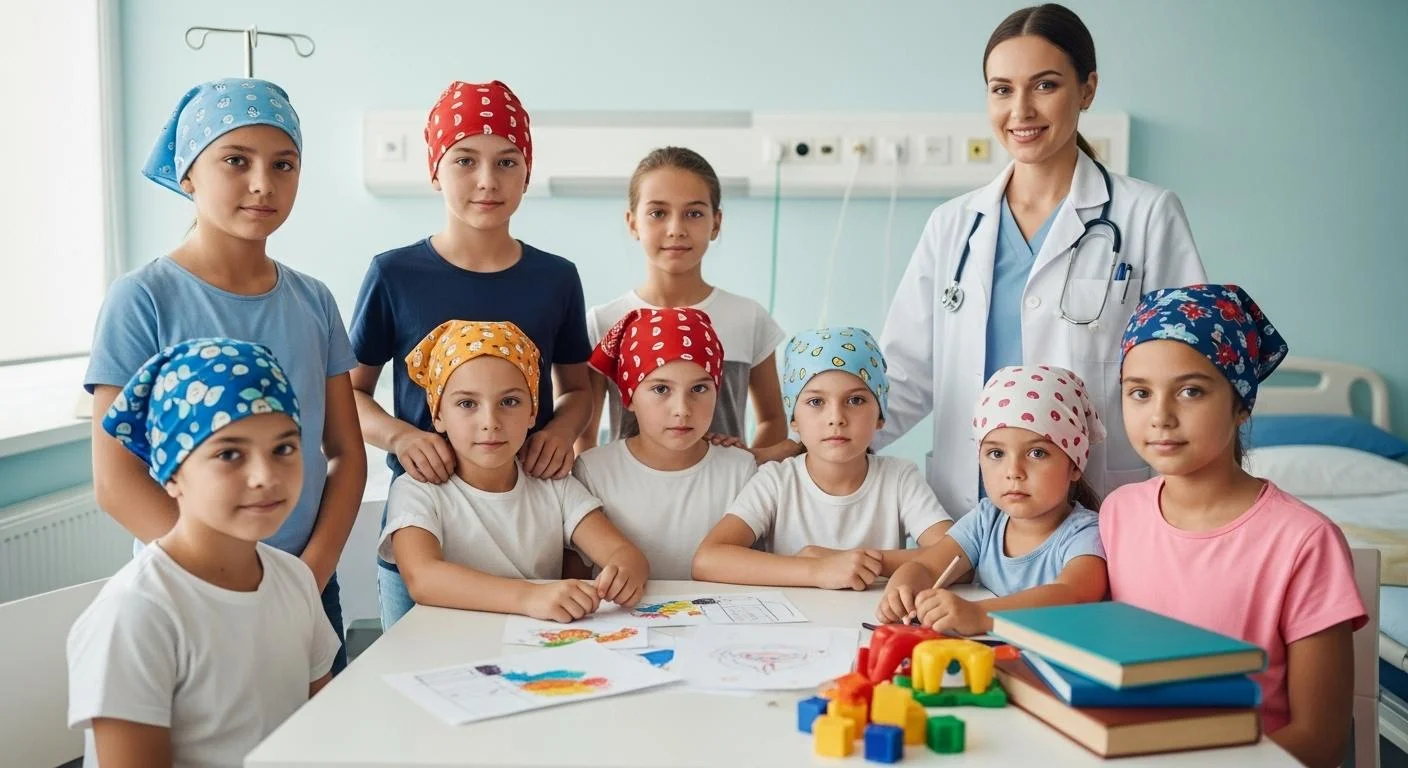
If you have ever come across a school covered in golden ribbons, children wearing glittery hats, teachers explaining cancer in simple words, then you have felt the strength of this collective mobilization. France multiplies initiatives on this specific day, not hesitating to focus on awareness everywhere and all the time.
French and international initiatives, what happens in February?
Concerts, "Run for Gold" challenges, educational days, solidarity chains, media like TikTok and Instagram relay all actions, personalities also wear the golden ribbon, posting unfiltered messages to their communities. Hospitals resonate with sounds, schools discover the power of testimony, students distinguish between compassion and commitment, discovering what is at stake just a few kilometers from their classrooms. The media impact, now inevitable, breaks taboos, changes perceptions. TV channels and radios systematically give a platform to the subject.
- Gatherings, debates, and shows emerge in French cities
- Creativity multiplies donations, solidarity disrupts prejudices
- Social networks amplify emotion, mobilize beyond borders
A mother, Pauline, shares in a parents' house near Villejuif, "My daughter Louise dreamed of returning to her class," she whispers, one morning of February 15, Louise holds a golden heart in front of the entire department, applauded by the team, her fragile smile breaking everything else. Impossible to forget this moment; everyone holds their breath, even the most seasoned.
The messages relayed on February 15, why maintain this course?
The urgency is read between the lines: act quickly, give the best chance, support tirelessly. Early diagnoses radically change the fate of so many children. Every donation finances progress, every message de-dramatizes, every meeting turns fear into courage. February 15 is not just another date; it is the annual marker of silenced hope and solidarity that refuses to accept helplessness. No need for grand formulas; International Childhood Cancer Day always carries the same promise: not to turn our backs.
You close the door on February 15, and you know that nothing stops, that every smile, every mobilization, counts more than one can believe. In 2025, the cause remains vibrant, carried by the knowledge, the commitment of caregivers, families, and citizens who never want to leave things to chance.