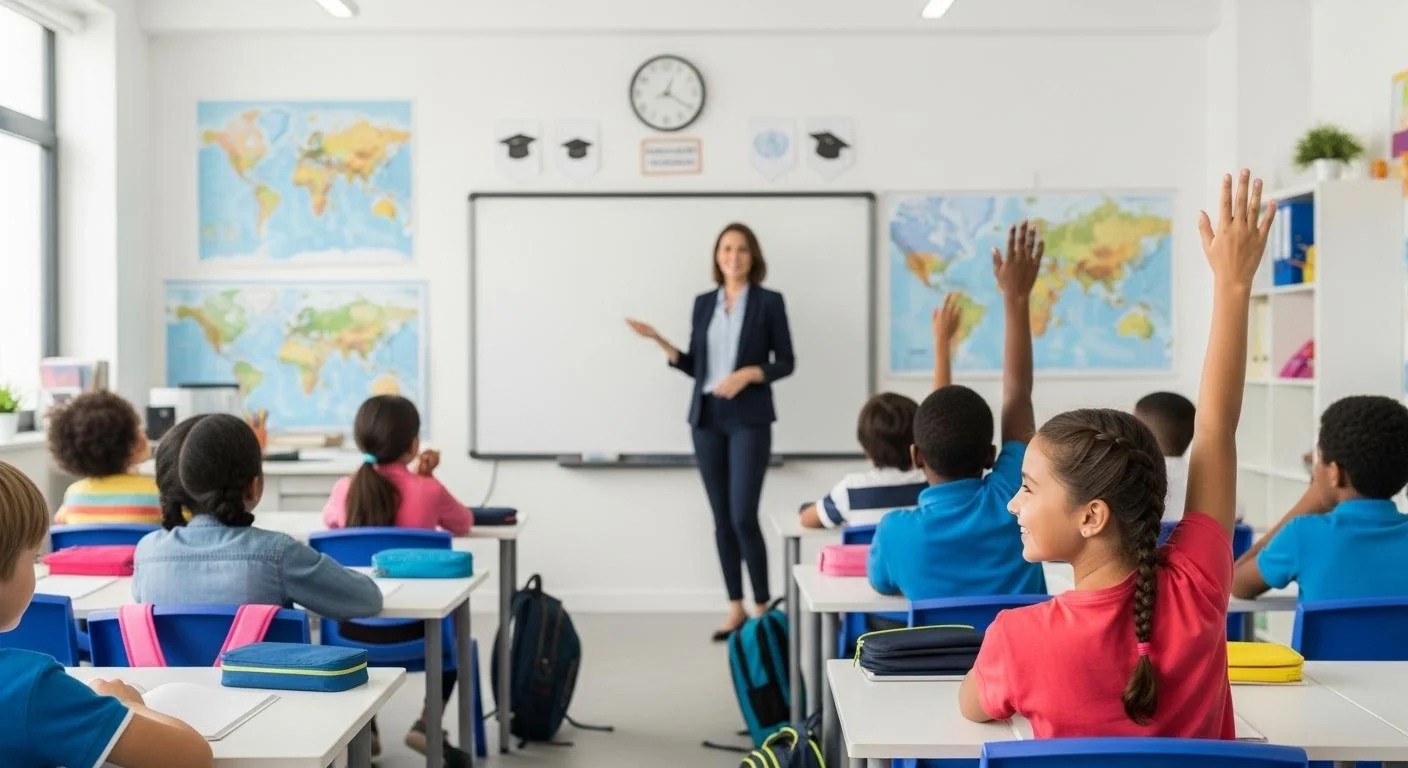
Global access to equitable education leaves no one behind, the numbers impose it, no artistic blur, no room for forgetfulness. January 24, International Day of Education, rekindles the certainty that so many children remain on the threshold of school in 2025. You ask? Why are there still so many excluded in the 21st century? This day tolerates neither indifference nor soft promises; it steps out of the ordinary. No more indifference, deserted classrooms become signs of a collective problem. The reality jumps out: 244 million children and youth deprived of school according to UNESCO. There is no more fertile date to put everything on the table than this International Day of Education on January 24. The event places its ambitions at the heart of discussions, questions, shakes consciences, sometimes shocks, and that's good. No one claims to ignore the situation after this day: neither do you.
The significance of January 24, International Day of Education
You become aware of the magnitude of the task; this is not a recent whim. History clings to the walls of 1948, the Universal Declaration of Human Rights imposes education as a priority. It was only in 2018 that the United Nations General Assembly officially recognized the International Day of Education. Nothing came out of a hat; civil societies, NGOs, activists, researchers, every actor has a voice. UNESCO orchestrates, compiles, federates, gathers until thirst is quenched to avoid forgetfulness. It is useless to believe that the world suddenly awakens in 2018; the path drags its fatigue, its power, its hesitations. This date places the right to education on the agenda of all governments, no one can dodge the question without blushing. Years go by, global forums stir, Dakar, Incheon, all debate and sometimes hurl insults. Always, this right to learn resurfaces, imposing its rhythm. January 24, International Day of Education, carves out a solid place in this landscape.
The historical context of a universal claim
History advances in small steps; nothing ever happens suddenly. January 24, this International Day of Education, slips into continuity; every institution tries to align with this duty of transmission. No government can lift its chin and say: “No, education can wait.” UNESCO carries the torch; the event is not an isolated gesture. Experts warn, civil society gets angry, NGOs are outraged. There is no hidden consensus; everything is discussed, sometimes confronted in the global arena. The march is never linear; every advance is accompanied by a jolt. This day does not do things by halves; it demands, strikes, claims, year after year.
The main objectives of the International Day of Education
| Objective | Target Impact |
|---|---|
| Promotion of universal access to quality education | Increase global enrollment rates, reduce the number of out-of-school children |
| Valuing inclusion and diversity in schools | Encourage social mixing and combat discrimination |
| Raising awareness of educational rights and equal opportunities | Make the principle of equal access effective, inform about protective laws |
The United Nations organizes each objective, not a detail forgotten. Inclusion runs through everything; neither borders nor clichés resist. January 24, International Day of Education, shakes up habits, makes walls tremble. The 2025 edition takes the stage; UNESCO's seat in Paris dons its garments of light, more than 150 countries will respond present. Elected officials, teachers, students from all backgrounds, the panel abolishes borders. Everywhere, companies want to partner, integrate the day into social agendas. Do you observe the phenomenon? Educational priorities impose themselves, perhaps for good.
Global educational challenges at the heart of the International Day
Some inequalities persist; the numbers never seek politeness. Sub-Saharan Africa leaves 33 percent of children out of school in 2025, a chasm; Europe sometimes scoffs, Southwest Asia falls 20 percent below the European average in primary education. Conflicts, silent poverty, gender discrimination, everything is intertwined, everything blocks access. Public policies struggle to correct the course; NGOs get involved, dig, denounce the invisible. The gap also slips into opulence; large cities, abandoned neighborhoods, segregation lurks. History sometimes depends on an address, a postal code; it’s absurd, yet it is reality. Do you question the responsibility of local actors? Some turn their heads; it’s hard to remain indifferent.
Contemporary challenges of digital education and inclusion
Impossible to ignore the digital shift. Europe struts: 95 percent of households are connected. Sub-Saharan Africa barely shows 37 percent, according to the ITU. Isolated students miss online classes; digital exclusion is not a slogan; it turns injustice into routine. The fight against discrimination stagnates; Finland advances, others lag behind. Stereotypes weigh heavily; minorities and people with disabilities remain apart. National policies sometimes initiate inclusion measures, slowly, too slowly; the situation does not really evolve. The International Day of Education on January 24 tackles this silence, opens the way for the invisible, migrants, refugees, every child relegated to the educational margins.
Real atmosphere, provincial school in France. Louise, 21 years of experience, closes the door, finds an awkward note: “Thank you, teacher, you speak our language.” Emotion cannot be written; her student from Nigeria has taken a step forward; his smile breathes life into the class; every teacher will share this thrill. “Inclusion, we feel it; it’s not just a concept.”
The impacts and concrete actions of the International Day of Education
The 2025 edition bursts with projects. UNESCO, UNICEF, the World Bank create coalitions; conferences are no longer limited to Paris. Campaigns against school dropout, workshops on inclusion, messages of hope scatter across all networks. The slogan imposes itself everywhere: “Education, the engine of living together”. Dakar shares its pioneering experiences; India multiplies educational festivals; keeping girls in school is imperative. Germany promotes mentoring; Colombia works to reduce the digital divide. Actions explode online: Renault, Orange, Google, all offer training and masterclasses; every actor bets on pedagogical innovation. The International Day of Education rebounds from one continent to another, digital or physical space, it doesn’t matter; the message gets through.
- NGOs multiply local initiatives
- Brands invest in vocational training
- Pedagogical masterclasses become widespread
- Forums share concrete feedback
Who are the personalities and organizations that truly engage?
Impossible to overlook Malala Yousafzai, Nobel Prize winner, who hammers her mantra: “One book, one pencil, one child, one teacher can change the world.” The NGO Education International brings together more than 400 teaching associations worldwide; unions and political representatives sound the alarm. In France, AFEV builds tutoring networks in underprivileged neighborhoods; UNESCO designates entire cities as “learning cities.” The Malala Fund intersects with the trajectory of Kailash Satyarthi, tireless activist against child labor. Do you feel it? These voices destabilize the status quo, propel education as the ultimate bulwark. Commitment does not just invite dreaming; it justifies its existence through action.
Future perspectives for universal education
Nothing gets resolved in a single January 24, International Day of Education; the challenges impose urgencies. Funding for school infrastructure must accelerate; no half-measures. Policies impose long-term free education; any delay empties the promise. The generalization of digital education plays out even in the most remote corners; without international cooperation, there is no progress. You see, every measure impacts the collective future. Inclusion is not decreed: it runs through teacher training; it is inscribed in every textbook, in every classroom. Communication must emerge from institutional corridors, target vulnerable populations, and celebrate local victories. No one is waiting for an annual signal day anymore: vigilance widens, society heats up.
The ambition of Agenda 2030 for true universal education?
| SDG 4 Objective | Implication of January 24 |
|---|---|
| Equitable access to quality education for all | Global mobilization on the International Day of Education to ensure awareness and monitor progress |
| Development of skills, especially digital | Key moments of sharing and initiatives on January 24 aimed at strengthening skills and reducing the technological divide |
| Inclusion of vulnerable groups | Increased visibility and advocacy for the rights of children outside the school system every January 24 |
| Strengthened international partnerships | The International Day of Education concentrates commitments, outlines the agenda for alliances, and accelerates campaigns |
The global day of education spares nothing; the bet invites itself into every sustainable development goal. UNESCO experts believe they can halve the number of out-of-school children by 2030. Difficulties persist; leaders hesitate; some murmur that education materializes the last true bulwark against exclusion or contemporary tensions, proof by actions. Educational investment brings cohesion, stabilizes societies, liberates the individual. Could this neighborhood remain the same if every child received this quality education? Ask your question; do not let the debate exhaust itself elsewhere.
On January 24, International Day of Education, there is neither pretense nor hollow discourse. Announcements go up in smoke without collective energy. And if tomorrow, the silence of these empty classrooms marked a pause? It is now up to you to give breath to the momentum launched by this International Day of Education.